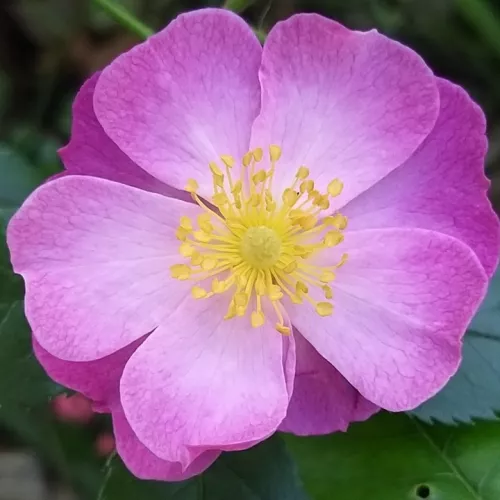
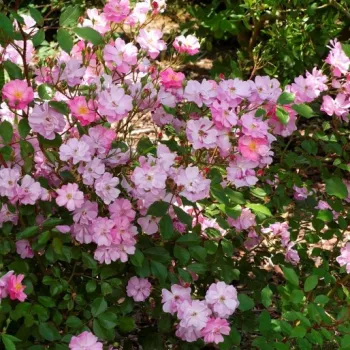
Delicate mallow-pink shade that fades to a soft lilac tone. - park rose - very weak, barely perceptible scented rose - fragrance description not available
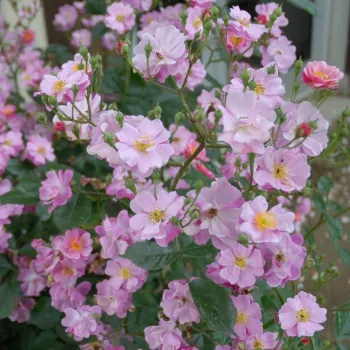
– Soft mauve-pink clouds of clustered blooms
– Abundant repeat flowering over a long season
– Low, spreading habit for beds and groundcover
– Proven hardy to H7 / USDA 5b
– Produces bright red decorative rose hips
– Special feature: ADR 1987 award for garden performance.
Unfortunately, we are currently unable to ship to the United Kingdom; we only deliver to countries within the European Union. For more information, please contact us!
3.5(5716)
Lavender Dream – Interlav shrub rose
Evoking afternoon tea beneath a leafy arbour, ‘Lavender Dream’ creates a soft-focus cottage atmosphere with its drifting clusters of mauve-pink blooms and gently spreading habit. This own-root shrub rose is grown in a handy 2‑litre container, so you can plant it almost any time the soil can be worked, even where you need to cope with drainage and heavier soils near the house. Masses of small, semi-double flowers open from vivid buds, fade through lilac-pink to a misty pastel veil, and drop cleanly to keep the plant looking neat without fiddly deadheading – ideal when you want romance without extra chores in a busy family garden. Its branching, ground-covering shape knits beautifully into cottage borders and kitchen gardens, while persistent red hips bring colour and wildlife value into autumn. Own-root growth provides reassuring longevity, quiet stability in windy, exposed plots, and easy regrowth if you ever need to prune harder after renovation or weather damage. Over the first few seasons it settles in steadily – first focusing on roots, then building strong shoots, before reaching full impact as a romantic, storybook backdrop to everyday life.
Freshly opened mauve-pink blooms of Lavender Dream.
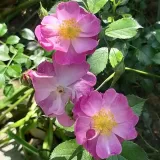
Lavender Dream in full bloom, showing pastel mauve-pink flowers.
Usage options
Target area
Reasoning
Low-maintenance cottage-style flowerbed in a family garden
The spreading shrub habit and good self-cleaning mean spent blooms fall away naturally, so the bed keeps its soft, lavender-pink haze with minimal work beyond an annual tidy. A practical choice for busy beginners.
Informal flowering hedge along paths or boundaries
Planted at hedge spacing, it forms a relaxed, semi-transparent screen with dense foliage and repeat flowering, giving privacy and colour without the rigid look of formal hedging. Ideal for traditional homeowners.
Groundcover for banks, edges and awkward corners
The broad, spreading framework and close planting densities allow it to knit together into a flow of foliage and blossom, suppressing weeds and softening hard edges while remaining easy to keep in bounds for urban gardeners.
Own-root shrub for long-lived, low-fuss borders
Being grown on its own roots avoids graft problems and encourages steady renewal from the base, so the shrub keeps its shape and flowering performance over many years with only periodic pruning, suiting time-poor families.
Coastal or wind-exposed family plots
The naturally spreading, moderately thorny framework anchors well and sways rather than snaps, staying presentable even when weather is unsettled and helping gardens that often face blustery, rain-laden days feel settled for seaside residents.
Part-shade planting near seating areas
Its tolerance of partial shade allows planting beside pergolas or garden benches, where clusters of soft pink-lilac flowers create a calm, intimate feel through the season without needing fussing over, appreciated by afternoon hosts.
Wildlife-friendly corner in kitchen or cottage garden
Semi-double blooms with open stamens welcome bees, and later the bright red hips provide autumn interest and natural bird food, bringing quiet movement and seasonal change into the plot for nature lovers.
Large container on terrace or small urban patio
In a 40–50 litre pot with good drainage, its compact height and spreading habit deliver a cloud of pastel colour close to the house, while own-root resilience and simple watering keep care straightforward for balcony owners.
Styling ideas
Cottage-Ribbon Border – Run ‘Lavender Dream’ as a soft ribbon along a path, underplanting with low catmint and parsley for a billowing, kitchen-garden feel – ideal for romantic cottage-style enthusiasts.
Pastel Focal Drift – Use three shrubs together in a lawn island, letting their spreading habit form a pastel mound that looks good from all sides – suited to families wanting an easy centrepiece.
Storybook Hedge – Plant as an informal hedge in front of picket fencing, with dwarf honeysuckle behind for evergreen structure and hips for autumn colour – perfect for traditional front gardens.
Shady-Seat Nook – Place the rose near a bench in light shade, adding spring bulbs and herbs at its feet for changing interest around a low-effort retreat – appealing to busy urban gardeners.
Terrace Feature Pot – Grow a single plant in a large, 50‑litre container on the patio, pairing with trailing thyme and low catmint to soften the rim – ideal for small-space balcony and terrace owners.
Technical cultivar profile
Parameter
Data
Name and registration
‘Lavender Dream’ (INTerlav), a shrub rose marketed in the Park - shrub rose group; also known under the commercial name Interlav Park - shrub rose INTerlav.
Origin and breeding
Bred by G. Peter Ilsink of Interplant Roses, Netherlands, from the cross ‘Yesterday’ × ‘Nastarana’; introduced and registered internationally in 1984.
Awards and recognition
Holds the ADR award (1987), indicating reliable garden performance, sound health and ornamental value under practical, unsprayed trial conditions in continental European climates.
Growth and structural characteristics
Spreading shrub 120–190 cm high and 120–200 cm wide, with dense, light green matt foliage and moderate prickles; forms a branching, ground-covering framework suitable for borders or mass planting.
Flower morphology
Small, flat, semi-double blooms (13–25 petals) carried in clusters on short stems; remontant, with abundant first flowering followed by a strong, repeat display later in the season.
Colour data and phenology
Mauve-pink flowers (RHS 64C, 75D) open mid-pink with a lilac tinge, then fade through pale lilac-pink to a soft, mallow-lilac tone, creating a gentle, pastel effect over the flowering period.
Fragrance and aroma
Fragrance is very weak and barely perceptible to most gardeners; overall appeal is based more on flower quantity, colour effect and form than on notable scent in typical garden conditions.
Hip characteristics
Frequently sets small, spherical bright red hips, around 6–10 mm across; hips add fine-textured autumn interest and can be used decoratively in simple, informal arrangements.
Resistance and winter hardiness
Hardy to approximately -26 to -23 °C (RHS H7, USDA 5b, Swedish zone 4); moderate overall disease resistance, with good powdery mildew resistance but only moderate tolerance of black spot and rust.
Horticultural recommendations
Best for beds, edging, parks, groundcover and urban green spaces; plant 90–165 cm apart depending on use, in well-drained soil with summer watering during extended dry spells.
‘Lavender Dream’ offers a spreading pastel display, self-cleaning flowers and bright hips in a long-lived own-root form that rewards patient gardeners seeking an easy, enduring cottage-style rose; a thoughtful choice for your next planting decision.
Detailed product attributes
Product Identification Data
Product Name:
INTERLAV – mauve-pink park rose - Ilsink
Product Type:
darinaROSE® ORIGINAL - 2-litre own-root potted rose
Pollinator Attraction:
Its open, semi‑double flower form with accessible stamens and strong fragrance make it highly attractive to pollinating insects.
Our product is a rose grown with pharmaROSA®’s unique cultivation technology!
2-litre, own-root, potted rose.
With a shoot system appropriate to the season.
With a root system that thoroughly permeates the growing medium.
Quality compliant with the requirements of the E.N.A. (European Nurserystock Association).
Supplied in unique packaging that prevents damage.
Can be planted during frost-free periods.
True-to-variety rose bush with a unique identifier.
The pharmaROSA® own-root potted rose is a well-rooted plant that supports reliable establishment when planted and cared for properly, so it can be planted whenever the soil is not frozen.
Crop overview: several varieties and growth stages in a short crop section.Shoot system: intensive growth of fresh basal shoots on a young plant.Root system: demonstration of a vigorous root system permeating the growing medium, by removing the pot.Balance: mature plant with root system and shoots in harmony with each other.
Information about the videos
The video series is not a “seasonal showcase”; it illustrates the essence of pharmaROSA® own-root cultivation in a tangible way: how the plant is built up, what the root system is like and how the shoot system regenerates. The recordings were therefore made at different times and with plants at various stages of development, so mixed foliage levels and differing stages of growth may appear in the videos. They are not a ‘sample’ of the batch dispatched, but a visual explanation of how the technology works. The current condition of the rose available to order — typical for the given period and similar to what you can expect to receive in the parcel — is shown in the upper part of the product page.
Pages for private customers Garden roses for the family garden, with minimal care → ORIGINAL® Premium garden roses – instant impact, a truly showpiece garden → EXTRA® Pages for professionals and private customers Roses for public spaces – large areas, sustainable maintenance → NATURAL® Roses for projects – hedge and row planting, fast implementation → RAPID® For professional partners only Production – propagation material for garden roses, wholesale → NEONATAL®
Company details
PharmaRosa Ltd. Company registration number: 01-09-717479 VAT number: 13075314-2-43 Plant health registration no.: HU130721 Bank account (IBAN): HU85117631891388688400000000 BIC (SWIFT): OTPVHUHB Bank name: OTP Bank Nyrt.