Sunblest – golden hybrid tea rose for romantic cottage borders
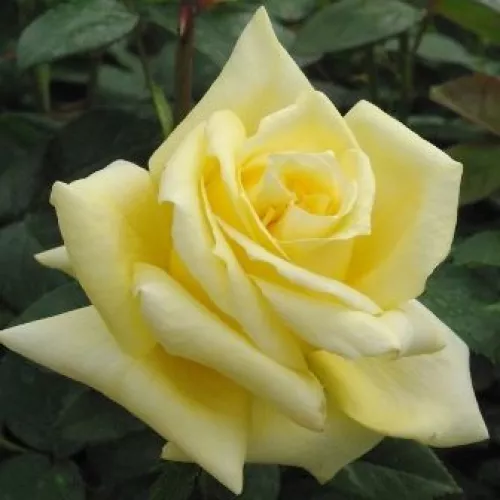
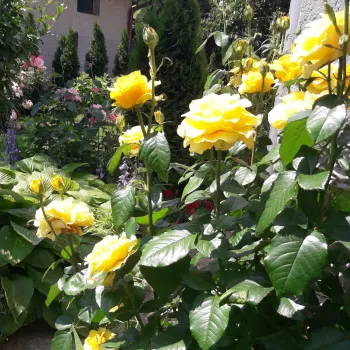
Bred by Tantau in 1970, Sunblest is a classic hybrid tea rose that brings a softly romantic note to family gardens with its upright growth, long-stemmed blooms and radiant, sunlit yellow flowers. Its clear golden petals hold their colour beautifully, even in unsettled British weather and in gardens where wind and showers regularly pass through. Container-grown on its own roots, it is designed for straightforward planting and a long, dependable life, gradually knitting into the border picture. Over time, this medium-height, neatly upright rose becomes a graceful focal point for cottage-style paths, lawns and kitchen gardens, offering plenty of cut stems for the house with just light seasonal care. As an own-root plant it renews itself from the base, helping to maintain shape, flowering and colour for decades with minimal fuss, ideal if you prefer reliable structure and a traditional border feel without complex pruning. Allow space for its 85–115 cm height, give it decent drainage on heavier clay soils, and it will reward you with repeat flushes of full, double blooms through summer. Think afternoon tea beneath a simple arbour, the air warm and still, the deep golden flowers of Sunblest glowing like a quiet sunset behind the cups – a steady, unhurried romance that fits effortlessly into everyday family life, from first planting to mature longevity.
Usage options
| Target area | Reasoning |
|---|
| Central feature in a small cottage-style border |
Its upright, medium-height habit and moderately dense, glossy foliage give clear structure without overwhelming a small space, making it easy to anchor a cottage-style bed with paths or lawn around it for homeowners wanting a traditional focal rose, especially beginners. |
| Cutting rose near a terrace or kitchen door |
The long, solitary hybrid tea stems and large, double flowers are excellent for cutting, while the colour holds well in the vase; planting it close to the house makes gathering blooms simple for those who enjoy bringing garden roses indoors, particularly busy-urban-gardeners. |
| Sunny mixed border in typical family gardens |
Best in full sun, Sunblest fits easily between perennials and low shrubs, repeating its golden-yellow flushes so the border never feels bare; a modest 85–115 cm height keeps maintenance straightforward for small to medium gardens tended by hobby-gardeners. |
| Raised bed or improved heavy-clay planting |
Where heavier soils hold winter wet, planting in a raised bed or well-drained pocket helps the own-root system establish and support regular flowering, giving stable ornamental value with modest upkeep in challenging ground conditions for typical family-gardeners. |
| Large container (40–50 litres or more) on patio |
In a generously sized pot, its tidy upright form and repeat flowering create a strong vertical accent without demanding complex pruning; the own-root plant builds a durable framework over time, suiting patios and courtyards managed by space-conscious homeowners. |
| Traditional front-garden path or low hedge run |
Planted 40–45 cm apart, Sunblest forms a low, formal line that softens drives and front paths with glowing yellow flowers, adding a welcoming, storybook touch yet remaining relatively easy to trim and deadhead for those favouring classic style, especially cottage-lovers. |
| Feature rose in a rural kitchen or cutting garden |
With remontant flowering and good colour retention, this rose offers a steady supply of uniform golden blooms for jugs and kitchen arrangements, blending naturally with herbs and vegetables for gardeners who like productive, nostalgic plots, particularly country-homeowners. |
| Long-term specimen for low-intervention family gardens |
As an own-root rose, it can regenerate from the base after hard pruning or winter damage, preserving form and flower quality for many years with simple annual care, an advantage for those wanting a durable planting that quietly endures, especially time-poor-owners. |
Styling ideas
- Golden-accent border – Combine Sunblest with threadleaf coreopsis and pale cream perennials to echo its clear yellow blooms, ideal for those seeking a light, sunwashed cottage feel around a small lawn.
- Box-and-rose path – Line a front path with dwarf boxwood and interplant Sunblest as glowing punctuation points, perfect for homeowners wanting a neat yet romantic entrance with minimal seasonal adjustment.
- Soft-grass backdrop – Plant Sunblest in front of Stipa tenuissima ‘Pony Tails’ so the feathery grass frames each golden flower, suiting gardeners who like movement and gentle contrast without fussy maintenance.
- Kitchen-garden cutting row – Run a short row of Sunblest beside herbs and vegetables to give reliable stems for vases, appealing to those who want their productive garden to look charming as well as useful.
- Patio-tea corner – Set a large container of Sunblest by a bench or small arbour, pairing it with scented herbs in pots for relaxed afternoon tea moments, ideal for busy urban gardeners creating a romantic escape.
Technical cultivar profile
| Characteristic | Data |
|---|
| Name and registration |
Sunblest is a hybrid tea rose; registered and traded as ‘Sunblest’, with ARS exhibition name Sunblest, used mainly as a garden and cutting variety in classic borders. |
| Origin and breeding |
Bred by Mathias Tantau Jr. (Rosen Tantau, Germany) from an unknown seedling × ‘King’s Ransom’; introduced and registered in 1970, representing mid-20th-century hybrid tea breeding. |
| Awards and recognition |
Winner of Tokyo Gold Medal at the Japan Rose Concours (1971) and Gold Star of the South Pacific plus National Rose Trial Ground honours in New Zealand trials in 1973, confirming strong ornamental value. |
| Growth and structural characteristics |
Upright shrub 85–115 cm high and 55–75 cm wide, with moderately dense, mid-green, glossy foliage and moderate prickliness; growth is balanced and suited to borders, paths and specimen planting. |
| Flower morphology |
Large, double hybrid tea blooms (26–39 petals) borne mostly singly on long stems; flowers are cup-shaped of medium height, remontant with an abundant second flush through the season. |
| Colour data and phenology |
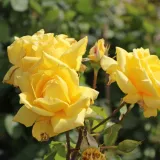
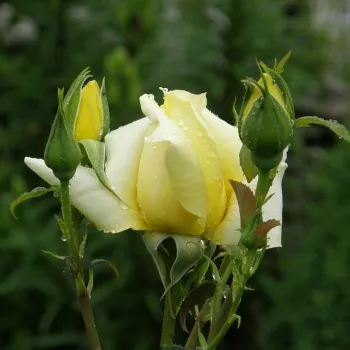
Intense, saturated golden-yellow blooms (RHS 14A outer, 14B inner) hold colour well, fading only slightly; buds open bright lemon yellow, maturing to deep golden yellow with a more saturated centre. |
| Fragrance and aroma |
Fragrance is very faint and barely noticeable, so it is chosen mainly for colour, form and cutting quality rather than scent; its double flowers also mean limited appeal for pollinators in wildlife-focused schemes. |
| Hip characteristics |
Occasionally produces small, spherical orange-red hips around 8–12 mm in diameter, adding a modest decorative note later in the season when flowers are fewer, though hips are not a primary feature. |
| Resistance and winter hardiness |
Rated to about −26 to −23 °C (RHS H7, Swedish zone 4, USDA 5b) with moderate resistance to black spot, powdery mildew and rust; benefits from normal hygiene and timely treatments in humid seasons. |
| Horticultural recommendations |
Best in full sun with regular watering during dry spells; plant 40–70 cm apart depending on use; deadhead to compensate for weak self-cleaning and give light annual pruning to maintain flowering structure. |
Sunblest offers upright structure, long-stemmed golden blooms and long-lived own-root reliability in a compact hybrid tea rose; consider it if you want a classic, easy-care feature for everyday garden enjoyment.