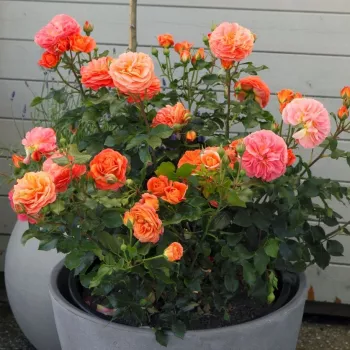
PHOENIX® – orange bedding floribunda rose – Kordes
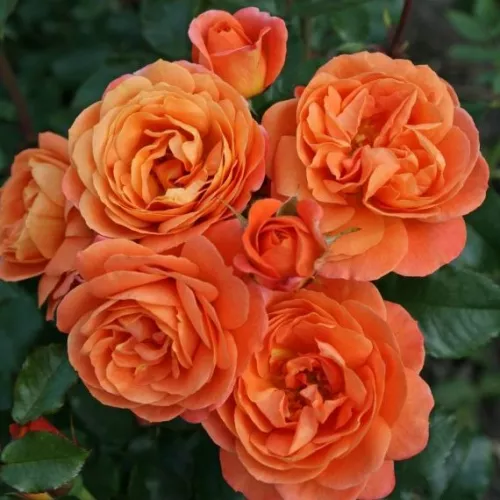
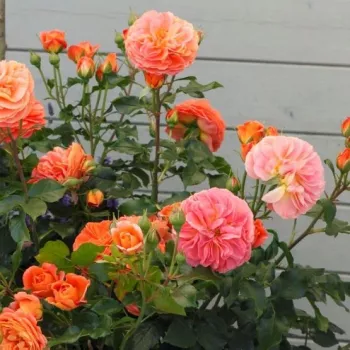
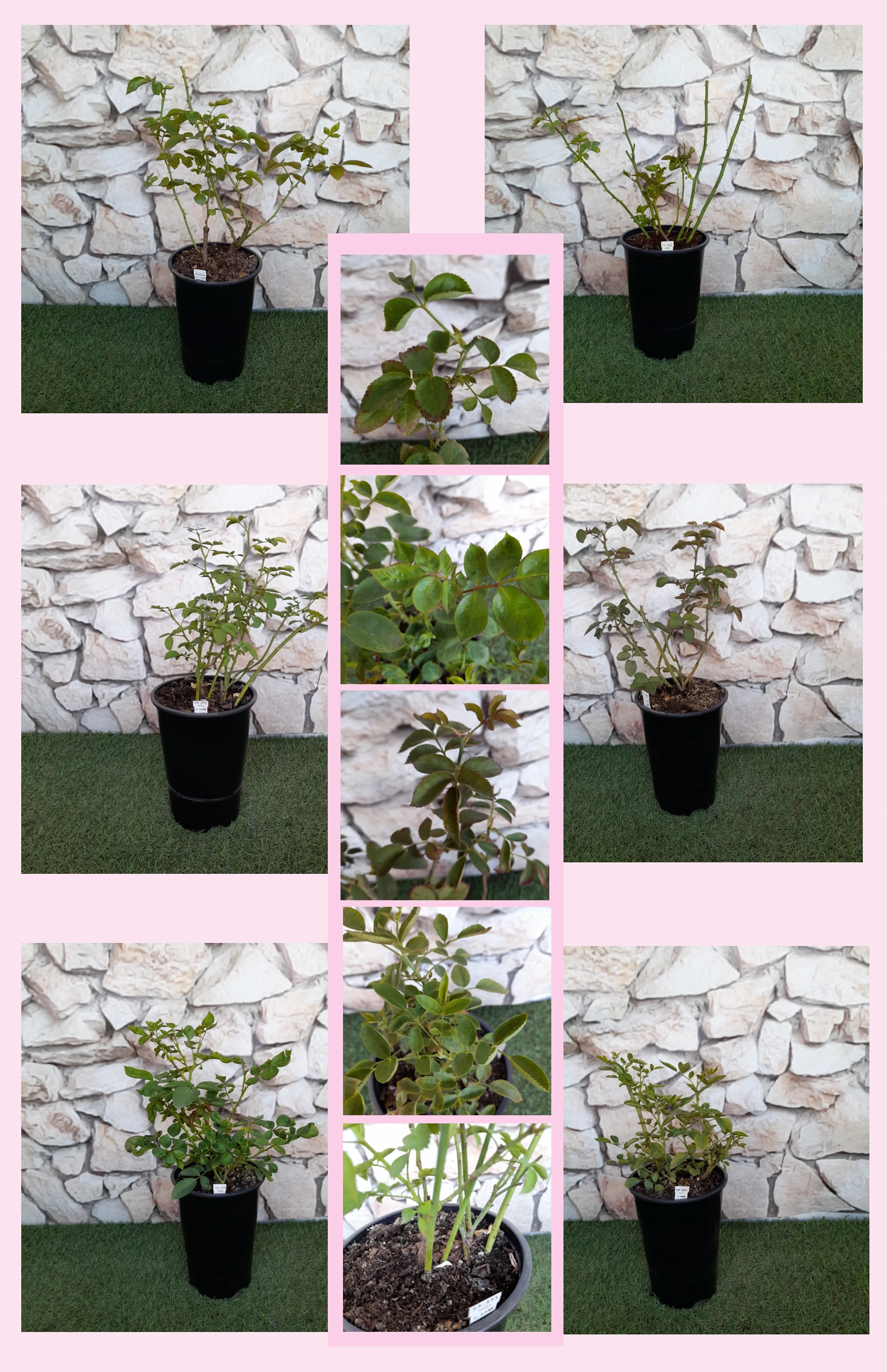
Bring a touch of storybook romance to your garden with PHOENIX®, a compact Kordes floribunda that flowers generously in clustered, very double blooms from early summer well into autumn. Its upright, bushy habit and glossy dark foliage create an easy-to-coordinate structure for family borders, low hedges and cottage-style beds, while the orange-red cups soften to warm, light orange‑pink as they age, giving an ever-changing palette through the season. Bred for good heat tolerance, it copes reliably with breezy, exposed sites where strong winds and driving rain can test lesser roses, remaining visually orderly with little deadheading needed day to day. As an own-root plant, PHOENIX® offers reassuring longevity, regenerating well from the base and maintaining stable ornamental value over many years, especially once its first-season roots, second-season shoots and third-year flowering framework are fully established. Happy in beds or large containers, this medium‑maintenance rose supports relaxed gardening routines, suits partial shade and rewards simple, consistent care with repeat flowering that frames afternoon tea or evening gatherings in an inviting, cottage‑style setting.
Usage options
| Target area |
Reasoning |
| Front-of-border cottage bed |
The compact, upright habit and 55–85 cm height make PHOENIX® ideal for the front section of a mixed cottage border, where it forms a neat, easy-to-read line of colour that does not swamp neighbouring perennials or herbs. Regular flowering and moderate self-cleaning create a consistently tidy look with minimal intervention, particularly valued where children pass close by and you prefer not to tackle heavy pruning or complicated shaping. Perfect for the time-pressed beginner |
| Romantic low hedge along paths or lawns |
Planted at around 35 cm for hedging, PHOENIX® knits into a dense, glossy barrier, its dark foliage giving a formal backbone while the warm orange-red blooms soften the outline. The relatively moderate prickliness helps define boundaries without making routine garden access awkward, and once established, own-root plants regenerate reliably from the base if individual stems are damaged, avoiding gaps. A reassuring choice for the style-conscious homeowner |
| Family flower bed in small to medium gardens |
With a spread of 40–60 cm, this variety fits comfortably into typical family beds, leaving room for simple companions like lavender, catmint or low salvias. Its remontant habit means that, after each flush, new buds follow quickly, so there is almost always something to admire from the kitchen window without constant feeding or complex scheduling. Especially suitable for busy families |
| Large patio container (40–50 litre and above) |
PHOENIX® adapts well to life in a large pot of at least 40–50 litres, where its compact framework and glossy leaves make an attractive focus beside a seating area or on a terrace. The good heat tolerance is particularly valuable on paved patios, and own-root plants respond well to the occasional renewal pruning required to keep container roses fresh over many seasons. A practical solution for space-limited urbanites |
| Partially shaded seating corner |
This cultivar copes reliably in partial shade, so it can brighten those corners that receive only a few hours of direct sun, such as the lee of a fence or north‑eastern aspect. Medium maintenance needs mean simple routines—watering in dry spells, basic feeding and light pruning—are enough to keep the plant full of blooms, even where conditions are a little cooler and less than ideal. Well suited to gently aspiring gardeners |
| Heat-exposed, slightly breezy sites |
Where borders are open to sun and wind, PHOENIX®’s good heat tolerance and resilient structure help maintain flower quality and foliage health in typical UK summers, provided it receives sensible watering during prolonged dry periods. This makes it a reliable choice for suburban front gardens or more open plots that can experience strong winds and driving rain without losing their carefully planned structure. A sound option for practical-minded buyers |
| Traditional bedding and edging schemes |
As a floribunda bedding rose, PHOENIX® excels in repeated blocks or ribbons, where its medium-sized clusters and repeat flowering create a continuous, formal carpet of colour. Square or hexagonal mass planting at the recommended densities quickly fills spaces without complex design work, allowing you to achieve a classic rose-garden look with straightforward, repeatable spacing principles. Ideal for lovers of traditional bedding |
| Low-maintenance, long-lived focal group |
Planted in small groups as own-root specimens, PHOENIX® develops into a durable, regenerative feature: if harshly pruned or affected by winter damage, new shoots arise from the root system, preserving the original character. Occasional renewal pruning and basic plant protection in extremely humid seasons are usually all that is required to sustain its ornamental value for many years. A thoughtful choice for long-term-focused planners |
Styling ideas
- Cottage Ribbon – Line PHOENIX® along a path with soft catmint and pink hardy geraniums to emphasise its compact structure and repeat flowering – for romantic cottage-style enthusiasts
- Kitchen-Edge – Border a kitchen garden with alternating PHOENIX® and low lavender to combine productive beds with warm colour and easy-care hedging – for home-growers who like order
- Patio Focus – Plant a trio of PHOENIX® in a 50-litre half-barrel, underplant with trailing thyme and white lobelia to enjoy long-season colour in a small footprint – for balcony and patio owners
- Soft Screen – Use a staggered row of PHOENIX® interplanted with airy grasses such as Stipa tenuissima to create a light, wind-tolerant screen that stays attractive with modest upkeep – for design-conscious minimalists
- Storybook Arch – Anchor each side of a honeysuckle-covered arch with groups of PHOENIX® to ground the climber in a glowing orange base, framing an inviting seating area – for lovers of fairytale garden corners
Technical cultivar profile
| Parameter |
Data |
| Name and registration |
Floribunda bed rose, collection Kordes, registered as KORrosobi; marketed as Phoenix® Kordes KORrosobi, approved exhibition name Phoenix, for garden and park use. |
| Origin and breeding |
Bred by Wilhelm-Alexander Kordes from cross ‘KORamflusa’ × ‘NOA75800’; introduced by W. Kordes in Germany in 2017, with EU registration application 2017/2305. |
| Awards and recognition |
Highly decorated: Baden-Baden Gold medal 2016, The Hague Golden Rose and first-class rating, multiple certificates of merit, plus Glasgow Audience award and Warsaw recognition. |
| Growth and structural characteristics |
Compact, upright bush reaching about 55–85 cm high and 40–60 cm wide, with dense, glossy dark green foliage and moderate prickles; suited to beds, edging and containers. |
| Flower morphology |
Cluster-flowering floribunda with medium-sized, cup-shaped, very double blooms of over 40 petals; remontant with notably abundant second flush, partial self-cleaning of spent flowers. |
| Colour data and phenology |
Flowers open vivid orange-red (RHS 26C/31B), later fading to light orange-pink while a yellowish base remains; colour retention moderate, giving a softly changing display as blooms age. |
| Fragrance and aroma |
Bred primarily for visual and structural effect rather than perfume; available descriptions indicate a very faint, barely perceptible scent, so it is chosen chiefly as an ornamental feature. |
| Hip characteristics |
Occasionally sets small spherical hips about 6–10 mm diameter, coloured red RHS 43A; numbers vary yearly, but they can add a discreet touch of late-season ornamental interest. |
| Resistance and winter hardiness |
Hardy to approximately −21 to −18 °C (RHS H7, Swedish Zon 3, USDA 6b); good powdery mildew resistance, medium tolerance to black spot and rust, generally robust foliage in normal seasons. |
| Horticultural recommendations |
Suited to beds, edging, hedges, containers and urban green space; medium maintenance, with standard feeding and pruning plus extra plant protection only in extremely humid conditions. |
PHOENIX® KORrosobi brings compact structure, repeat flowering and dependable heat tolerance in a durable own-root form that matures gracefully, making it a thoughtful long-term addition to a relaxed family garden planting.