PENELOPE HOBHOUSE – white park rose - Scarman
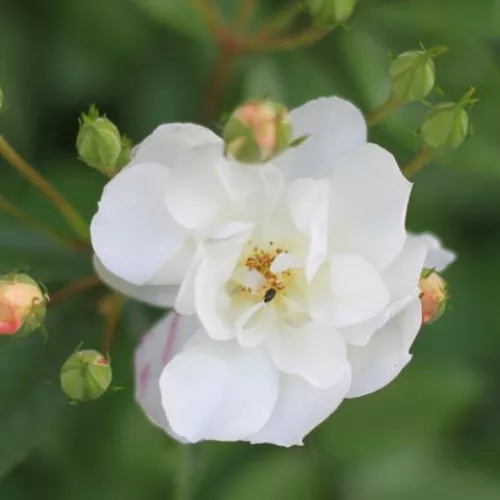
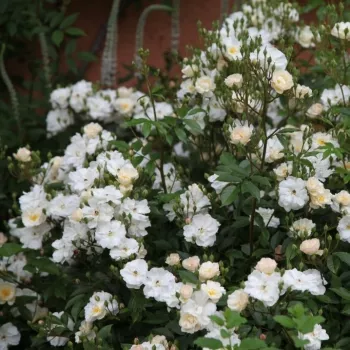
Created by rose breeder John Scarman, PENELOPE HOBHOUSE is a bushy Hybrid Moschata shrub rose that brings a quietly romantic, English-cottage feeling to family gardens with its milky-white, semi-double blooms and soft musky fragrance. It is naturally well-suited to British gardens where you may face blustery weather and heavy soil, coping reliably even when drainage is less than perfect if you plant in a raised bed or improved border. The dense, light green foliage and moderately thorned stems form an elegant, arching framework that is ideal for a relaxed hedge, obelisk or low arbour, flowering in generous clusters from early summer with a particularly abundant second flush. As an own-root rose, it settles steadily and endures for years, quietly regenerating from its base and building up a stable shape with long-lasting ornamental value. You will notice roots establishing in the first season, strong new shoots in the second, and by the third year a fully developed, storybook display that needs only light, flexible pruning to keep it in character, making your cottage-style planting feel genuinely timeless, subtly musky, charmingly clustered, naturally romantic, reassuringly hardy, welcomingly pollinator-friendly and pleasantly low-maintenance.
Usage options
| Target area | Reasoning |
|---|
| Informal cottage border near a terrace |
The bushy, arching habit and milky-white clusters create a soft, romantic backdrop to seating areas, perfect for afternoon tea and relaxed family use, with minimal pruning and care needed for beginners. |
| Low, informal flowering hedge |
Its dense foliage and steady 130–200 cm height make an attractive, semi-transparent boundary that flowers repeatedly through summer, with own-root resilience giving a long-lived hedge for traditionalists. |
| Obelisk or small arbour by a path |
Long, flexible stems can be tied to a simple obelisk or light arbour to create a storybook entrance; remontant flowering keeps it in bloom, with sparse thorns making access easier for families. |
| Mixed border with perennials in heavy soil |
This hardy shrub copes well where heavier clay can be an issue if planted in a slightly raised, well-drained bed; its cluster blooms and light green foliage blend beautifully with cottage perennials for gardeners. |
| Feature rose in a large container |
Suited to a 40–50 litre or larger pot, it offers cottage-garden charm on patios or small urban spaces; own-root vigour and low maintenance mean dependable flowering with basic watering for busy-owners. |
| Lightly shaded wall or fence |
Tolerant of partial shade, it performs well on east- or west-facing boundaries, where the white flowers brighten gloomy corners and the musky scent adds atmosphere for shade-gardeners. |
| Pollinator-friendly wildlife corner |
Semi-double flowers with accessible stamens and moderate fragrance provide useful pollen and nectar, while rose hips follow for autumn interest, supporting a softer wildlife aesthetic for nature-lovers. |
| Cutting patch in a kitchen garden |
Clusters of small, cup-shaped blooms with a musky note suit informal jugs and kitchen-table bunches, and the long-lived, own-root framework keeps stems coming year after year for home-florists. |
Styling ideas
- Cottage-Arbour – Train PENELOPE HOBHOUSE over a light arch with Campanula poscharskyana at the base to soften edges – ideal for lovers of romantic, storybook entrances.
- Kitchen-Border – Combine with low Hemerocallis cultivars and herbs for a scented cutting-and-cooking strip beside the patio – ideal for home cooks who enjoy gathering flowers and flavours.
- Soft-Hedge – Plant as an informal hedge, underplanting with Gypsophila repens ‘Knuddel’ to fill gaps with airy white clouds – ideal for those wanting gentle structure without formal clipping.
- Patio-Pot – Grow one plant in a 50-litre terracotta container with trailing bellflower to spill over the rim – ideal for small-plot or balcony owners seeking a cottage effect in limited space.
- Morning-Corner – Place near a breakfast terrace where its musky fragrance and pale blooms catch early light – ideal for anyone who savours quiet, reflective moments outdoors.
Technical cultivar profile
| Parameter | Data |
|---|
| Name and registration |
PENELOPE HOBHOUSE – white park rose - Scarman; Hybrid Moschata shrub rose, park type, own-root; commercial use in borders, hedges, small climbers and feature plantings. |
| Origin and breeding |
Bred by John Scarman, Germany, 2003; descendant of Rosa moschata × Rosa soulieana, introduced by Scarman Roses as a natural-looking, romantic shrub for gardens and parks. |
| Growth and structural characteristics |
Bushy shrub with arching stems, 130–200 cm tall and 120–180 cm wide; light green, slightly glossy foliage, sparsely thorned canes and moderately self-cleaning flower clusters. |
| Flower morphology |
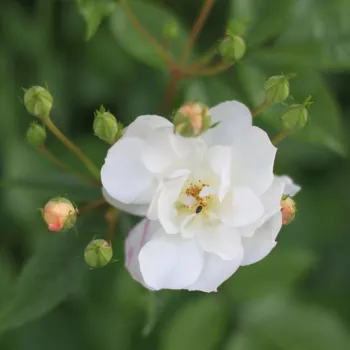
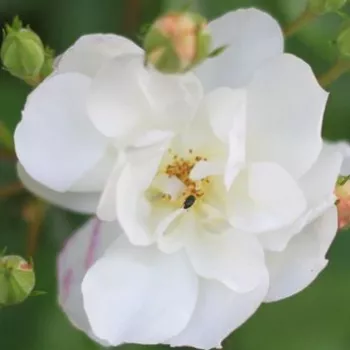
Semi-double, cup-shaped blooms, 13–25 petals, small-flowered but borne in large, showy clusters; remontant with an abundant second flush for a long cottage-style display. |
| Colour data and phenology |
Milky-white petals with creamy tints; buds show soft pink overlay, fading to pure white (RHS 155C–155D); colour holds reasonably in garden conditions with gentle, gradual lightening. |
| Fragrance and aroma |
Fresh, medium-strength musky scent clearly perceptible on warm days; characteristic Hybrid Moschata perfume that enhances seating areas and blends well with other scented plants. |
| Hip characteristics |
Moderately abundant ellipsoidal hips, 10–16 mm diameter, orange-red; follow flowering and provide late-season colour and wildlife interest if spent blooms are not deadheaded. |
| Resistance and winter hardiness |
Good overall health with resistance to black spot, powdery mildew and rust; hardy to approximately −21 to −18 °C (RHS H7), suitable for most UK regions with basic care. |
| Horticultural recommendations |
Low-maintenance; suitable for borders, hedges, containers, small climbers and specimens; plant 90–165 cm apart; thrives in improved clay or loam with regular watering in long dry spells. |
PENELOPE HOBHOUSE offers romantic cluster blooms, a fresh musky fragrance and long-lived own-root reliability, making it a graceful, easy-care choice for cottage-style family gardens worth considering.