ROSA MOYESII 'EOS' – pink wild rose – Ruys
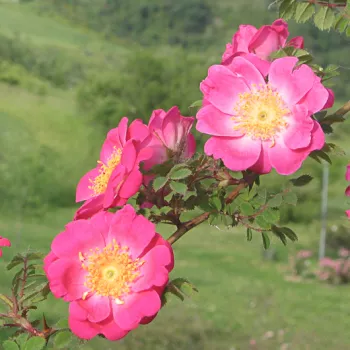
Invite a sense of storybook romance into your family garden with Rosa moyesii ‘Eos’, a graceful, tall shrub whose simple, single pink blooms and bottle-shaped red hips bring an airy woodland charm to cottage-style borders and hedges. This own-root botanical rose is bred for endurance, forming a long-lived, quietly majestic structure that settles in well even where soils are heavy, provided you offer reliable drainage and a little initial care. Once established, its upright, bushy habit provides reliable seasonal structure with good heat tolerance and modest water needs, while the open flowers are a summer magnet for bees and other pollinators. As the years pass, the shrub matures into a permanent feature, its ornamental red hips feeding birds and adding autumn interest, making ‘Eos’ a natural choice for relaxed, wildlife-friendly borders.
Usage options
| Target area | Reasoning |
|---|
| Romantic cottage hedge along a garden boundary |
The tall, upright shrub form and once-flowering summer display create a loose, traditional hedge that screens lightly without feeling oppressive. Well-spaced plants form a flowing line that fits cottage-style front or side boundaries and needs only periodic shaping for those seeking a soft, low-effort enclosure, ideal for the busy homeowner. |
| Solitary statement shrub near a seating or tea area |
As a single specimen, ‘Eos’ develops into a distinctive, vase-like shrub that anchors a small lawn or gravel sitting area with its natural architecture and seasonal hips. The own-root form supports long-term stability and regeneration, so the plant matures year after year into a reassuring focal point with minimal structural maintenance, well suited to the patient gardener. |
| Wildlife-friendly corner in a family garden |
The single flowers invite bees and other beneficial insects, while the red hips provide autumn and winter food for birds, making ‘Eos’ a strong choice for a small wildlife haven. Used at the back of a mixed border, it quietly supports biodiversity without demanding intensive care, particularly attractive to the nature-loving family. |
| Informal mixed shrub border with perennials |
Placed towards the rear of a border, its height and airy branching add relaxed structure behind herbaceous plants such as Echinacea and Echinops. The soft pink flower colour blends readily with country-style palettes, while the self-cleaning blooms reduce deadheading, offering gentle impact with modest input for the cottage-border enthusiast. |
| Naturalistic screen for compost, sheds or utility areas |
The vigorous, upright growth and medium-density foliage lend themselves to softening the view of compost bays or outbuildings. Once settled, the shrub copes well with sun and periods of dryness, helping hide practical corners without constant clipping, which is particularly practical for the time-pressed gardener. |
| Park-style planting in larger family plots |
In bigger gardens, groups of ‘Eos’ can frame mown paths or orchard areas, echoing traditional parkland style on a domestic scale. The combination of height, wildlife interest and modest pruning needs makes it an enduring backbone shrub that fits families who want an unfussy, characterful setting, especially the long-term planner. |
| Back-of-border anchor in heavy or challenging soils |
Used in raised beds or improved ground, the robust shrub habit lets ‘Eos’ form a reliable backdrop even where conditions can be cool and damp at times, provided the site is not waterlogged. Its tolerance of sun and established drought means you can trust it to hold its place with few interventions, reassuring for the beginner gardener. |
| Wild rose strip along a driveway or rural boundary |
Planted in a loose line, this botanical rose forms a relaxed screen that welcomes pollinators in summer and offers hips and shelter later in the year, while coping well with breezy, exposed aspects once rooted in. Over time it becomes a quietly romantic feature that complements hedging and meadow-style verges for the country homeowner. |
Styling ideas
- Cottage-Hedge Charm – Plant ‘Eos’ in an informal hedge with gaps for perennials like coneflowers and blue globe thistle to weave through, creating a soft, pink-and-blue country edge – perfect for lovers of relaxed cottage style.
- Arbour Backdrop – Use a single shrub as a tall backdrop beside a bench or simple pergola, underplanted with low Euonymus fortunei ‘Minimus’ to carpet the base – ideal for those imagining afternoon tea in a secluded nook.
- Wildlife Ribbon – Run a loose row along a fence, mixing in native-friendly shrubs and meadow grasses so bees, butterflies and birds move through the garden as a living corridor – suited to families prioritising nature support.
- Kitchen-Garden Frame – Place ‘Eos’ at the corners of a vegetable or herb plot, where its hips and arching outline lend old-world character without overshadowing beds – appealing to home-growers who like a traditional potager feel.
- Pastel Woodland Edge – Combine this wild rose with lilac, foxglove and airy grasses to soften the transition from lawn to trees, letting its single pink blooms glow in dappled light – ideal for gardeners creating a storybook woodland margin.
Technical cultivar profile
| Parameter | Data |
|---|
| Name and registration |
Rosa moyesii ‘Eos’, botanical shrub rose in the wild rose group; commercial name Rosa moyesii 'Eos' Botanical rose Ruys; ARS exhibition name ‘Eos’; unregistered cultivar in formal registers. |
| Origin and breeding |
Hybrid Moyesii shrub bred by Ruys at Koninklijke Kweekerij Moerheim, Dedemsvaart, Netherlands, from Rosa moyesii × ‘Magnifica’ (Hesse, 1916); introduced around 1950 as a botanical garden and landscape rose. |
| Growth and structural characteristics |
Strong, upright, bushy shrub reaching about 200–300 cm in height and 150–260 cm in spread; moderately thorny, with medium-green, matt foliage of moderate density, forming a tall, naturally arching framework over time. |
| Flower morphology |
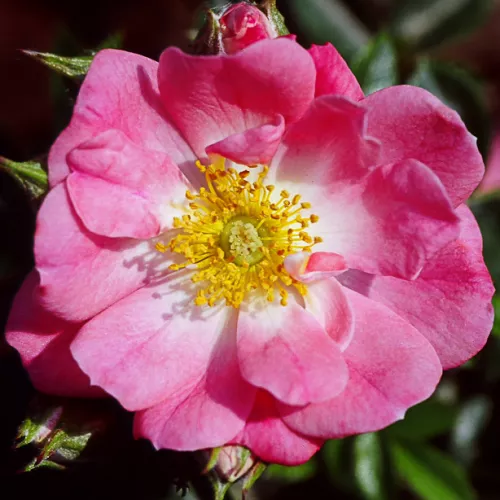
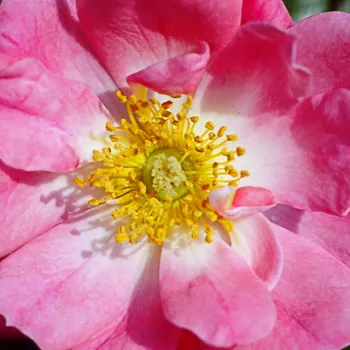
Medium-sized single blooms, usually 5–12 petals, flat and cluster-flowered; once-flowering in early summer rather than remontant; self-cleaning habit with most spent blooms dropping naturally, reducing deadheading work. |
| Colour data and phenology |
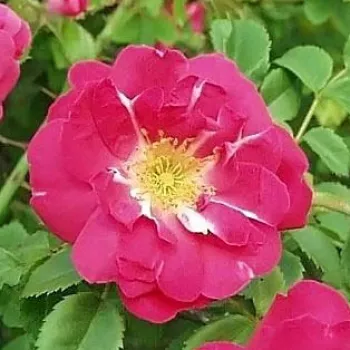
Solid vivid pink flowers (RHS 40B outer, 40C inner; ARS RB), opening raspberry-fuchsia with a lighter halo and golden stamens, then softening to pastel pink and finally a faint lilac-ashen veil before petals fall. |
| Fragrance and aroma |
Fragrance very weak and barely noticeable; chosen more for colour, form, hips and naturalistic presence than for scent; suitable where visual impact and wildlife value are prioritised over strong perfume in planting plans. |
| Hip characteristics |
Produces decorative red, bottle-shaped hips about 15–23 mm across; moderately borne along the stems, extending ornamental interest and supporting birds and small wildlife into late autumn and early winter. |
| Resistance and winter hardiness |
Hardy to approximately –32 to –29 °C (USDA 4b, RHS H7, Swedish zone 5); tolerates heat and periodic drought once established; disease resistance medium for black spot, mildew and rust, needing occasional monitoring. |
| Horticultural recommendations |
Best in full sun with reasonably drained soil; moderate maintenance, including structural pruning every few years. Recommended spacings: 140 cm for groups, 120 cm for hedges, 220 cm for specimens; avoid deep shade and waterlogging. |
ROSA MOYESII 'EOS' offers enduring shrub structure, wildlife-friendly hips and flowers, and long-term stability from its own-root form; a thoughtful choice if you seek a quietly romantic, low-fuss presence in your garden.