MADAME ANISETTE® – cream-white hybrid tea rose - Kordes
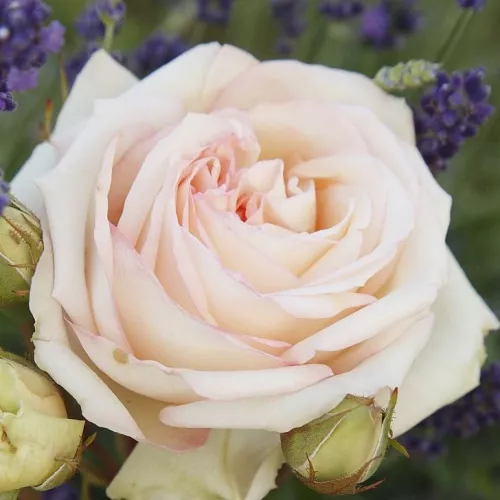
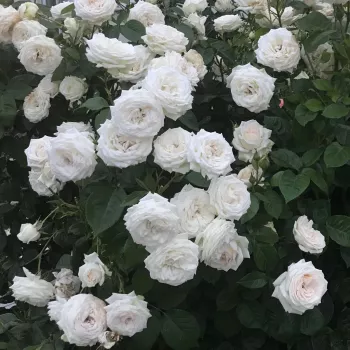
With its elegant, cream-white blooms and powerful aniseed perfume, MADAME ANISETTE® brings a sense of romance to everyday garden life, even in exposed gardens where breezes and showers are frequent thanks to its good weather resilience. This hybrid tea rose forms an upright, bushy structure that slips easily into cottage-style borders, yet also works beautifully as a solitary feature near a terrace or seating area. Its repeat-flowering habit provides generous continuity of colour from early summer onwards, while the dense, dark green foliage underlines the refined contrast of the blooms. Bred for reliable health and low-input care, this own-root rose offers reassuring longevity for those who want an indulgent, perfumed rose without complicated routines.
Usage options
| Target area | Reasoning |
|---|
| Romantic focal point near a seating area or arbour |
The tall, upright habit and very full, pompon-like flowers create a classic focal point at eye level, ideal beside a bench or pergola where the strong aniseed fragrance can be appreciated in still evening air, particularly suiting lovers of scented spaces. |
| Mixed cottage border with informal perennials |
Its bushy, 120–160 cm framework sits comfortably mid-border, threading creamy-white flowers through looser planting of herbaceous perennials, giving a relaxed English cottage feel without demanding intensive care, appealing to busy family gardeners. |
| Low-maintenance, long-lived feature in a family garden |
As an own-root rose it matures steadily into a durable shrub, regenerating well from the base and maintaining ornamental value over many years with modest pruning, reassuring for homeowners seeking permanence. |
| Season-long colour in a smaller urban garden |
Repeat flowering with a plentiful second flush means the plant delivers reliable colour and scent across the season, even where space is limited, so one or two plants can carry a compact plot for months, ideal for time-poor city gardeners. |
| Roses for gardens with higher disease pressure |
ADR-level resistance and proven tolerance to common fungal diseases mean the foliage remains attractive with minimal spraying, a practical choice where damp, enclosed gardens or past problems make reliability important for health-conscious gardeners. |
| Cutting bed for home-arranged flowers |
Large, full, hybrid tea blooms on strong stems lend themselves to cutting, allowing you to bring the sophisticated cream-white flowers and distinctive fragrance indoors for arrangements, pleasing enthusiastic home florists. |
| Heat-exposed, sunny borders |
Good heat and moderate drought tolerance, combined with colour that barely fades, keep the plant looking composed through warm spells between waterings, suiting south-facing beds cared for by practical weekend gardeners. |
| Freestanding specimen in a generous container |
Planted in a large 40–50 litre container with free-draining compost, its upright bushy form and enduring fragrance create a moveable highlight for patios or doorways, especially attractive to balcony and terrace owners. |
Styling ideas
- Arbour-Tea – Train two or three plants near an arbour entrance and underplant with lavender for a creamy-white, scented welcome – for those who dream of afternoon tea in a storybook corner.
- Cottage-Ribbon – Thread along a border with pink foxgloves and airy baby’s-breath to create a soft, feminine “ribbon” of bloom – for romantic gardeners who like a gentle, pastel palette.
- Kitchen-Edge – Position as a refined border between kitchen garden beds and lawn, teamed with herbs such as rosemary and chives – for home cooks who want beauty beside practicality.
- Moonlit-Patio – Place in a large terracotta pot with silver-leaved companions so its pale flowers glow at dusk – for urban balcony and terrace owners seeking evening atmosphere.
- Country-Hedge – Plant in a loose row at 40–50 cm spacing, weaving in catmint and lady’s mantle for a soft, informal hedge – for families who favour traditional countryside structure.
Technical cultivar profile
| Characteristic | Data |
|---|
| Name and registration |
Hybrid tea rose, Parfuma® collection; registered as KORberonem, marketed as Madame Anisette® Parfuma®. Recognised exhibition hybrid tea, ARS approved exhibition name Madame Anisette®. |
| Origin and breeding |
Bred by Tim-Hermann Kordes (Germany) for W. Kordes’ Söhne, from unnamed seedling parents; registered 2016, introduced after 2016 as part of the modern, scented Parfuma® range. |
| Awards and recognition |
Multiple international rose trial honours, including ADR (2014), Label Rouge (2016), Tokyo bronze, Rome silver, Bagatelle merit, Lyon third prize, Belfast and Kortrijk gold medals for garden and exhibition value. |
| Growth and structural characteristics |
Upright, bushy shrub to around 120–160 cm tall and 60–80 cm wide, with dense, slightly glossy dark green foliage and moderate prickles; forms a well-filled framework suitable for borders or specimen use. |
| Flower morphology |
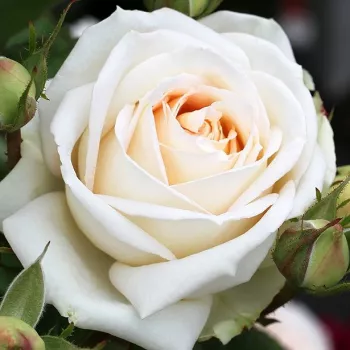
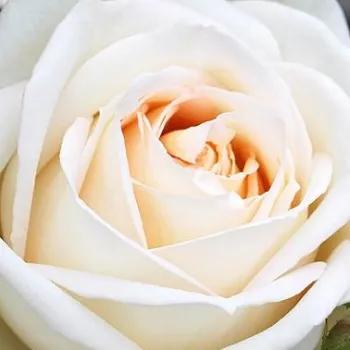
Large, very full double hybrid tea flowers with 40+ petals, borne mainly in small clusters; spherical to pompon-shaped blooms providing a classic, formal appearance suited to both garden display and cutting. |
| Colour data and phenology |
Cream-white flowers with faint peach tones; buds greenish-white, opening to rich creamy white, ageing to ivory with slight yellowish tint. Colour retention is good, with only lightening in strong sunlight. |
| Fragrance and aroma |
Very strong, spicy-sweet scent with distinctive aniseed and myrrh notes, noticeable from a distance; an ornamental perfume rose, primarily valued for sensory impact rather than pollinator support. |
| Hip characteristics |
Rosehips produced only occasionally because of the very double flowers; when present they are small, about 10–14 mm, ovoid, orange-red and generally of minor ornamental significance. |
| Resistance and winter hardiness |
High disease resistance to black spot, powdery mildew and rust; reliably hardy to around –26 to –23 °C (RHS H7, USDA 5b, Swedish zone 4), suitable for exposed, cold-prone and mixed-climate gardens. |
| Horticultural recommendations |
Best in full sun with fertile, well-drained soil; tolerates partial shade. Space 40–75 cm depending on use. Low maintenance, needing periodic deadheading and light pruning to maintain shape and flowering. |
MADAME ANISETTE® offers refined cream-white blooms, powerful fragrance and healthy, long-lived performance on its own roots, making it a cultured choice for those planning a romantic, low-effort garden feature.