LENADBIAL – Matchball shrub rose for cottage-style gardens
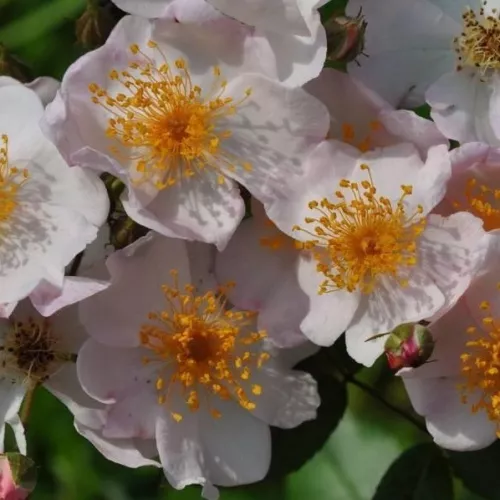
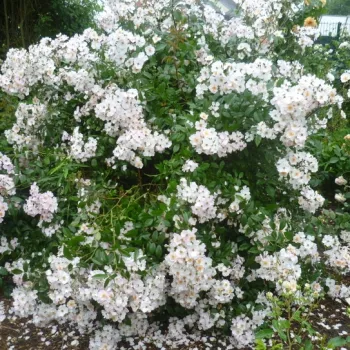
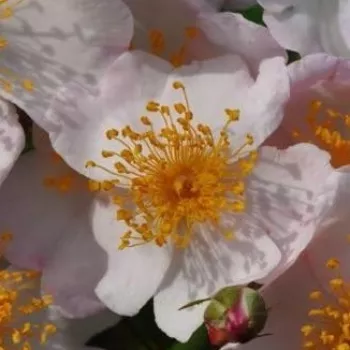
‘Matchball’ LENADBIAL brings a romantic, storybook sense of afternoon tea to family gardens, with dainty white flower clusters that appear in generous waves from early summer onwards. Its compact, gently arching habit slips easily into cottage-style borders, kitchen gardens and informal hedges, offering pollinators an inviting landing place thanks to its simple, open blooms and golden stamens. This own-root shrub settles securely even where winds can be brisk and soil heavier, especially when you improve drainage a little for more reliable anchoring. Once planted, it needs only straightforward seasonal care, as most spent blooms fall away by themselves and decorative hips follow in autumn, supporting local wildlife and extending interest well beyond peak flowering. In a generously sized container or bed, it matures into a light, mid‑green screen of foliage dotted with porcelain-white flowers, giving that “girly” English countryside feel without demanding expert pruning: you can trim it hard, shape lightly, or simply remove the oldest stems every few years. Because it is supplied as a young, own-root rose, it is designed for longevity and dependable regrowth, with roots establishing first, then stronger flowering shoots, before reaching its full ornamental impact over the first three years.
Usage options
| Target area |
Reasoning |
| Small to medium cottage-style flowerbed |
The compact, moderately dense habit and repeated white flushes make this rose ideal for edging a cottage-style border without overwhelming nearby perennials. Self-cleaning flowers reduce deadheading, while own-root resilience supports a long-lived, low-fuss planting for busy beginners. |
| Informal flowering hedge along a path |
Planted at 50–60 cm intervals, LENADBIAL forms a soft, lightly thorny hedge, easy to keep in bounds with simple annual trimming. Its open structure and translucent white blooms give a friendly boundary that stays attractive for many seasons thanks to the inherent durability of own-root plants for family gardeners. |
| Wildlife-friendly corner of a family garden |
The single to semi-single blooms provide accessible pollen, encouraging bees and other beneficial insects, and the small orange-red hips add late-season food and colour. This combination of nectar and hips supports local wildlife while still fitting a neat domestic setting for nature lovers. |
| Mixed kitchen garden or potager border |
Its modest height and compact spread allow it to tuck between herbs, low fruit bushes and annual vegetables, lending a soft white accent without casting heavy shade. The straightforward care regime suits productive gardens where time is limited but charm is welcome for country-style cooks. |
| Large container on terrace or patio |
In a 40–50 litre or larger container with good drainage, the compact framework and moderate vigour adapt well to pot culture. Occasional feeding and watering are usually sufficient, and own-root growth means it can be renewed by pruning without fear of losing the variety for urban balcony owners. |
| Low-maintenance front garden or entrance |
Matchball offers a tidy, welcoming presence with its light mid-green foliage and porcelain-white clusters that refresh themselves through the season. The good self-cleaning habit, combined with simple annual shaping, keeps maintenance modest while providing a consistently cared-for look for time-poor homeowners. |
| Mixed shrub and perennial planting on heavier soil |
This shrub rose copes reliably in typical British garden conditions when planted with some drainage improvement, giving stable anchorage even where soil is on the heavier side and exposed to blustery days. Its steady, repeat flowering adds structure and charm with ordinary care for practical planners. |
| Long-term landscape or park-style scheme |
Own-root construction and medium maintenance needs make LENADBIAL suitable for longer-term schemes where plants are expected to persist with only periodic renewal pruning. Over time, it develops into a durable, repeat-flowering element that underpins a traditional, romantic layout for landscape enthusiasts. |
Styling ideas
- Cottage-Ribbon – Line a narrow path with LENADBIAL and low catmint, echoing an English cottage walk with gently arching white flowers – ideal for lovers of romantic, storybook gardens.
- Kitchen-Companion – Place this rose at the edge of a kitchen bed with chives and dwarf asters, blending utility and prettiness – suited to home cooks who enjoy traditional potagers.
- Wildlife-Drift – Combine LENADBIAL with asters and calamint to form a soft drift that feeds bees and later birds with hips – perfect for families wanting a child-friendly wildlife corner.
- Frontage-Frame – Use a loose row of shrubs under windows with lavender and low box for a calm, welcoming frontage – good for homeowners seeking tidy charm with little complexity.
- Patio-Accent – Grow one plant in a large terracotta pot with trailing thyme at the rim to create a fragrant, low-care terrace focal point – right for urban gardeners short on space and time.
Technical cultivar profile
| Parameter |
Data |
| Name and registration |
LENADBIAL, Hybrid Musk shrub rose marketed as Matchball; commercial type park rose within the Park – shrub rose group, verified authenticity for darinaROSE ORIGINAL own-root production. |
| Origin and breeding |
Bred by Louis Lens in Belgium from Rosa multiflora var. adenochaeta Ohwi × ‘Kathleen’; introduced and registered in 1990 by Lens Roses following selection in 1987. |
| Growth and structural characteristics |
Compact shrub 80–140 cm high and 45–80 cm wide, lightly thorny, moderately dense, mid-green, slightly glossy foliage, forming a fine-textured, bushy framework suited to borders and informal hedging. |
| Flower morphology |
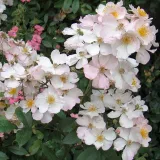
Small, flat, single to semi-single flowers, 5–12 petals, in large corymbs of 10–30 blooms per stem; remontant with a notably abundant second flush after the main early-summer flowering. |
| Colour data and phenology |
Porcelain white with a faint pinkish tint in the throat; buds show a pale pink veil, then open to pure white with prominent yellow stamens; colour remains mainly white, only lightly cream before petals fall. |
| Fragrance and aroma |
Very weak scent with a fresh, muscat-like character detectable at close range; fragrance is not dominant, so it suits mixed schemes where visual effect and pollinator value are the priorities. |
| Hip characteristics |
Moderately abundant, small, globular orange-red hips about 6–10 mm across; follow flowering, extending ornamental and wildlife interest into autumn without overwhelming the compact shrub structure. |
| Resistance and winter hardiness |
Rated H7, hardy roughly to −21 °C; medium resistance to powdery mildew, black spot and rust; appreciates fresh, moderately moist soils and benefits from basic preventive care in humid seasons. |
| Horticultural recommendations |
Plant 50–60 cm apart for hedges, wider for specimens; suitable for beds, edging, parks, mixed borders and large containers; prefers improved drainage, occasional feeding and light annual pruning. |
LENADBIAL Matchball offers compact, repeat white flowering, good self-cleaning and wildlife-friendly hips on a durable own-root framework, making it an easy, long-lived choice for relaxed, romantic family gardens you may wish to consider.