GESCHWINDS ORDEN – purple-pink historic old garden rose - Geschwind
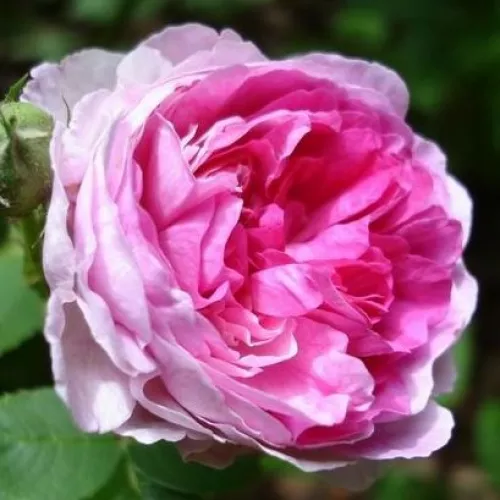
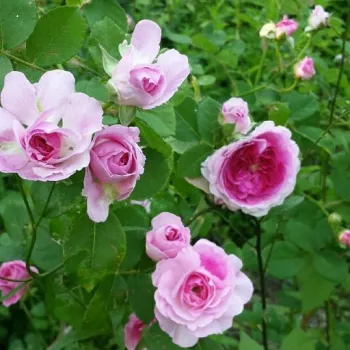
This heritage climbing rose brings a distinctly romantic, almost storybook ambience to pergolas, arbours and cottage-style fences, with rosette blooms in rich, old-fashioned colour that fade beautifully through lilac and silvery pink. Tall, flexible canes create natural screening and an intimate backdrop for afternoon tea beneath an arbour, while its sparsely thorned stems make everyday access and tying-in easier for busy gardeners. Bred in 1880 and introduced in 1885, it offers a sense of living heritage that suits traditional family gardens and rural kitchen-plot borders. On its own roots this plant establishes steadily for a long, reliable lifespan and secure anchoring even in exposed, breezy gardens near the coast, settling in with minimal maintenance once planted. Given a generous planting hole and simple care in the early seasons, it rewards you with robust growth and an increasingly atmospheric display year after year.
Usage options
| Target area | Reasoning |
|---|
| Arbour for afternoon tea |
Strong, climbing growth allows you to roof an arbour or arch with dense, leafy canes and clusters of rosette blooms, creating dappled shade and privacy for seating areas in small to medium family gardens – ideal for romantic traditionalists |
| Cottage-style fence or boundary |
Tall height and long spread make this rose excellent for softening garden boundaries, giving informal, old-world structure while keeping visibility; the once-a-year flowering becomes a seasonal highlight that marks early summer in the calendar – perfect for nostalgic homeowners |
| Feature on a pergola walkway |
The rich, shifting flower colour provides a striking tunnel of blossom over paths, with dark green, matt foliage as a calm foil; own-root vigour supports a long service life with predictable regrowth if pruned back after flowering – reassuring for long-term planners |
| Low-maintenance historic focal point |
As a solitary specimen on a sturdy support, its heritage character and once-flowering habit reduce ongoing deadheading; routine annual tidy and occasional pest checks are usually sufficient to maintain an attractive outline – suitable for time-poor gardeners |
| Climbing rose for exposed, breezy sites |
Robust rootstock-free anchoring and hardy wood give confidence in cooler, wind-touched parts of the UK, supporting stable growth and ornamental value even where summer weather is unsettled by frequent rain and brisk coastal winds – helpful for coastal residents |
| Own-root plant for longevity |
Being grown on its own roots, the plant can regenerate from the base if stems are damaged, keeping the same historic character without risk of rootstock suckers and supporting decades of service with straightforward pruning – attractive to value-focused buyers |
| Raised bed or trained in large containers |
Where soil is heavy, training this climber from a raised bed or a very large 40–50 litre container simplifies drainage management while still letting the roots spread, offering flexibility for paved terraces and compact urban plots – ideal for busy city gardeners |
| Structured backdrop for mixed cottage borders |
A generous planting distance lets its medium-dense foliage form a leafy curtain behind perennials; once its roots knit in during the first year and stems build in the second, you can expect full ornamental presence from around the third season – reassuring for patient beginners |
Styling ideas
- Cottage-Arbour – Train along an arbour with underplanting of catmint and old-fashioned foxgloves to frame a bench as a seasonal retreat – for lovers of soft, romantic structure.
- Kitchen-Hedge – Use as a loose, flowering screen behind herbs and vegetables, letting its historic character link ornamental beds with a productive kitchen garden – for families who enjoy a traditional potager feel.
- Pastel-Partner – Combine its changing crimson-pink tones with pale campanulas and white daylilies along a fence for a layered pastel wash – for gardeners focused on gentle colour harmonies.
- Heritage-Focus – Plant as a single specimen on a tall wooden obelisk, with low mounds of lady’s mantle and hardy geraniums to emphasise its 19th-century origins – for collectors of historical varieties.
- Screen-Softener – Soften a utilitarian boundary or shed wall, pairing with evergreen shrubs such as cherry laurel and late-summer coneflowers for year-round depth – for owners wanting discreet yet characterful screening.
Technical cultivar profile
| Parameter | Data |
|---|
| Name and registration |
Historical hybrid Multiflora climbing rose, traded as Geschwinds Orden; unregistered cultivar in formal registers but long established in heritage collections and marketed as a historic, old garden rose. |
| Origin and breeding |
Bred by Rudolf Geschwind in Hungary around 1880, introduced by Ketten Frères in 1885; parentage (Rosa rugosa × Rosa multiflora) × Rosa rugosa ‘Alba’, combining species toughness with traditional garden appeal. |
| Growth and structural characteristics |
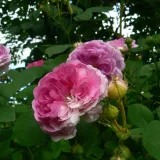
Vigorous climber 350–550 cm high, 240–380 cm spread; moderately dense, matt dark green foliage, sparsely thorned canes requiring support on arches, pergolas or fences to display their full height and flowering potential. |
| Flower morphology |
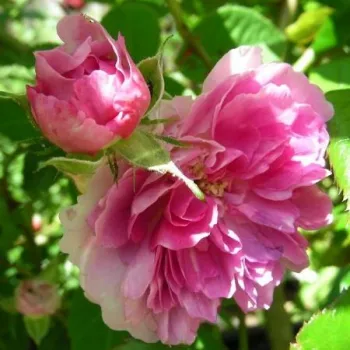
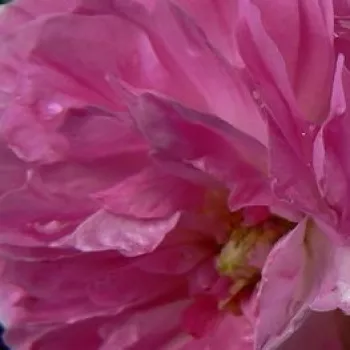
Medium-sized, very double, rosette blooms in clustered trusses; once-flowering in early summer with more than 40 petals per flower, giving a classic quartered appearance suited to heritage and exhibition displays. |
| Colour data and phenology |
Crimson-pink buds with deep purplish-crimson centres; opening to purplish-lilac pink with pale, almost white outer petals, gradually fading to dusty, silvery pink; ARS code MAU, RHS 65C outer and 72A inner petal zones. |
| Fragrance and aroma |
Fragrance is very weak and often barely noticeable; grown primarily for its colour, flower form and historic presence rather than scent, so best combined with fragrant companion plants if perfume is an important design element. |
| Hip characteristics |
Rose-hip set is usually sparse due to very double flowers; where formed, hips are small, spherical, approximately 10–14 mm diameter, with an orange-red colour adding modest late-season ornamental interest. |
| Resistance and winter hardiness |
Hardy to approximately –37 to –34 °C (RHS H7, Swedish Zon 6, USDA 3b); disease resistance generally medium to common foliage diseases, so standard monitoring and occasional treatments may be required in humid conditions. |
| Horticultural recommendations |
Best on a sturdy support in sun or light shade; plant 180–330 cm apart depending on use, allow strong framework canes to develop, then prune after flowering; own-root plants suit long-term gardens and responsible, value-based planting. |
GESCHWINDS ORDEN offers romantic climbing structure, atmospheric historic colour and durable own-root growth for long-lived planting, making it a thoughtful choice for relaxed, traditional family gardens.