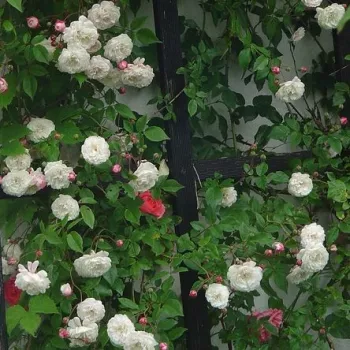
FÉLICITÉ ET PERPÉTUE – white historic rambler rose (climbing/trailing) - Jacques
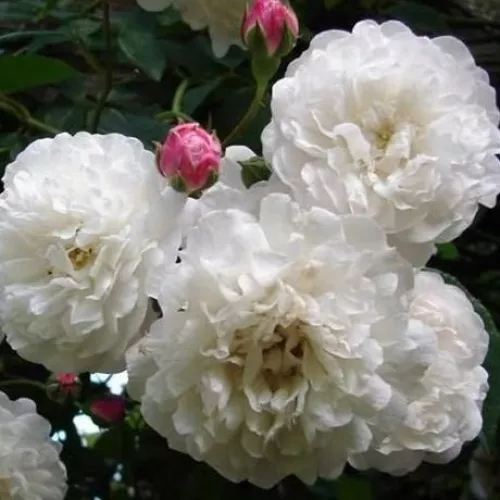
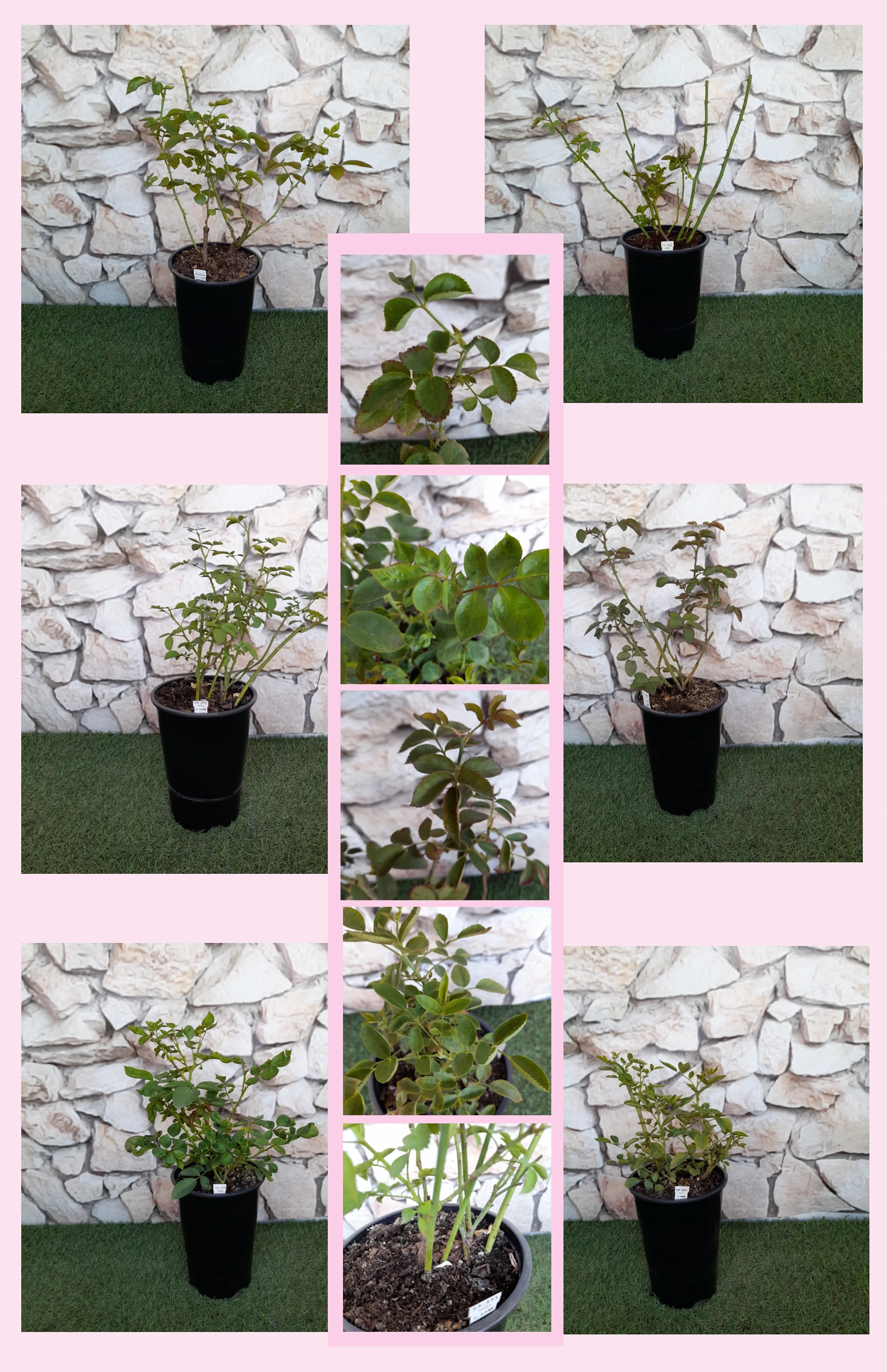
This historic rambler brings an atmosphere of secluded romance to pergolas, arbours and old garden walls, covering them in billowing clusters of creamy-white pompon flowers that feel straight from a storybook cottage garden. Its naturally healthy foliage and proven reliability mean you can enjoy a mature, enveloping arbour effect without constant spraying or fuss, even where damp winds and heavy showers often test less resilient roses along the coast and in exposed spots. As an own-root plant it offers reassuring longevity, rebuilding from the base if stems are damaged and keeping its character over decades. Once established, its good heat tolerance and sturdy root system give dependable coverage with little extra watering, while sparse prickles make tying in and redirecting shoots pleasantly manageable. With a single, spectacular early-summer display that stays neat with only light post-flowering attention, it is wonderfully low-maintenance yet impressively traditional in mood, ideal if you like your garden to feel romantic but still practical to live with.
Usage options
| Target area | Reasoning |
|---|
| Family pergola or arbour seating area |
Forms a dense, arching canopy of foliage and small pompon blooms, perfect for framing a bench or afternoon tea corner in early summer. Once tied in, growth is largely self-covering, with minimal pruning needed beyond occasional thinning, suiting beginners and time-poor gardeners who still want a romantic focal point for families. |
| House wall or garage wall (sun or light shade) |
Its vigorous, climbing habit quickly clothes plain brickwork or outbuildings, while tolerance of partial shade and poorer soils allows good performance on north-east or west-facing aspects. Own-root robustness means it copes well with the rigours of UK walls, from cold winters to occasional water stress, with only basic tying-in and spent cluster tidying for homeowners. |
| Boundary fence or informal screen |
Used along a fence, this rambler develops into a deep, leafy screen with a soft, traditional look that contrasts nicely with standard closeboard panels. The once-a-year flowering is intense, creating a spectacular privacy curtain in early summer, and after that it mainly asks for space and light rather than frequent pruning from neighbours. |
| Training into a mature tree |
Its long, flexible shoots can be guided into the lower branches of a sturdy tree, where they will weave through the canopy and send down curtains of creamy-white clusters. Because it is own-root and long-lived, it matures gracefully with the host tree, making an enchanting woodland-edge feature that needs little beyond initial training by adventurous gardeners. |
| Large country-style mixed border backdrop |
At the back of a deep border, it provides height and a softly textured green wall behind perennials like lupins and airy grasses, while the once-flowering display becomes the border’s early-summer highlight. The dense foliage remains attractive afterwards, and limited disease issues mean less worry about spraying in family spaces for health-conscious buyers. |
| Heritage or period-style front garden |
This 19th-century French rambler instantly reinforces a historic or cottage façade, pairing beautifully with clipped hedging, brick paths and kitchen-garden planting. Its restrained fragrance and tidy, very double blooms give a composed, old-world charm, while low general maintenance fits the realities of busy households seeking authenticity for traditionalists. |
| Low-intervention family garden with clay or chalk soil |
Good disease resistance and tolerance of moderate drought allow it to thrive once established, even where soil is heavy or not perfectly improved. Planted with sensible drainage or in a raised bed, it copes reliably with changeable UK summers and wetter spells, so demanding conditions do not constantly dictate your gardening schedule as a beginner. |
| Large container or planter by terrace (40–50 litres+) |
In a substantial container with a robust support, it delivers vertical charm for small gardens or rented spaces, combining dense foliage with a single, showy summer flush that can be underplanted with herbs or shade-tolerant perennials. Own-root resilience supports the natural progression from strong roots to building shoots to full display over the first three years for committed renters. |
Styling ideas
- Cottage-arch – Train over a simple wooden arch, underplant with pink lupins and foxgloves for a June storybook entrance – ideal for romantic front gardens.
- Kitchen-nook – Let it clothe a pergola beside the vegetable patch, pairing with dwarf heucheras and terracotta pots for a gentle, old-fashioned work-and-rest corner – ideal for homely kitchen gardens.
- Tree-curtain – Guide stems into a sturdy apple or ornamental tree to create falling garlands of creamy-white blooms above a lawn – ideal for spacious family lawns.
- Pastel-backdrop – Use it as a high, leafy screen behind mixed borders of soft pinks, whites and silvery foliage, allowing the once-flowering curtain to anchor the scheme – ideal for classic cottage borders.
- Courtyard-haven – Grow in a 50-litre half-barrel with a rustic trellis, combining with grasses such as Panicum ‘Sangria’ and scented annuals for a relaxed small-space retreat – ideal for compact urban patios.
Technical cultivar profile
| Characteristic | Data |
|---|
| Name and registration |
Félicité et Perpétue is a historic hybrid Sempervirens rambler; current trade name FÉLICITÉ ET PERPÉTUE – white historic rambler rose (climbing/trailing) - Jacques; unregistered but widely recognised. |
| Origin and breeding |
Bred by Antoine Jacques in France, 1820s, at the Château de Neuilly gardens for Louis-Philippe, Duke of Orléans; a cross of Rosa sempervirens and a Noisette rose, introduced in 1827. |
| Awards and recognition |
Holds the Royal Horticultural Society Award of Garden Merit (1993), confirming reliable performance under UK conditions; also decorated in American rose shows as a notable Dowager Queen rambler. |
| Growth and structural characteristics |
Very vigorous climbing habit, typically 5–8 m high with 3–5 m spread; dense, glossy mid-green foliage and relatively sparse prickles; suitable for walls, pergolas, arches, tree-climbing and large structures. |
| Flower morphology |
Produces numerous small, very double pompon flowers (around 0.5–1.5 inches) in large clusters; once-flowering in early summer, with moderate self-cleaning, though some spent clusters benefit from light trimming. |
| Colour data and phenology |
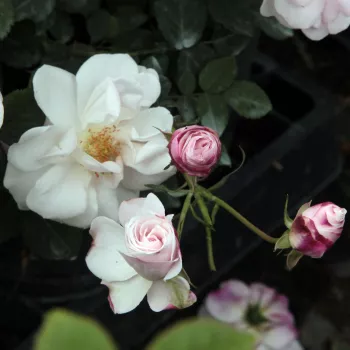
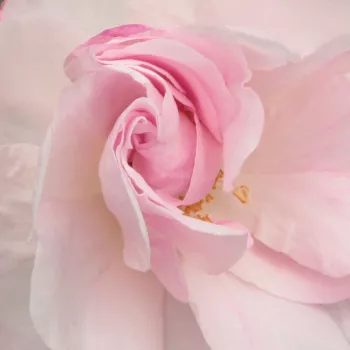
Buds open pale pink-cream, quickly turning creamy white, then clean off-white at full bloom; colour holds well in sun with little fading, creating a soft, uniform effect across the plant during peak flowering. |
| Fragrance and aroma |
Displays a classic rose character but with very weak intensity; scent is present only at close range and not a dominant feature, making it suitable where strong perfume might be overwhelming or undesirable. |
| Hip characteristics |
Occasional small, spherical orange-red hips around 8–12 mm form after flowering; numbers vary by season, adding modest late-season interest without creating heavy self-seeding or significant litter. |
| Resistance and winter hardiness |
Shows good resistance to powdery mildew, black spot and rust, with low chemical input needs; reliably hardy to approximately -21 to -18 °C (RHS H7), suiting most UK regions with typical winter conditions. |
| Horticultural recommendations |
Best in full sun to partial shade with reasonable drainage; ideal for pergolas, walls, arbours, hedgelines and tree training; plant at generous spacing and give strong support to accommodate its mature vigour. |
FÉLICITÉ ET PERPÉTUE offers romantic once-a-year abundance, strong disease resistance and dependable coverage, all on a long-lived own-root framework that rewards patient gardeners who would like a quietly impressive, low-effort climber.