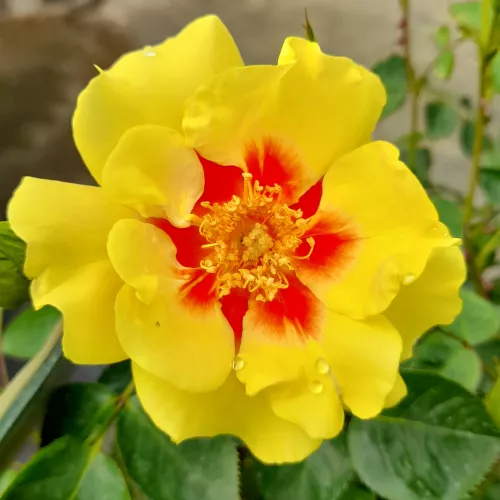
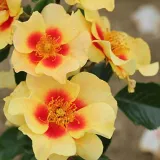
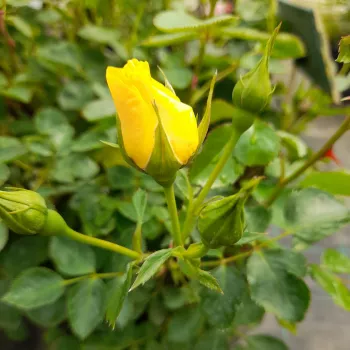
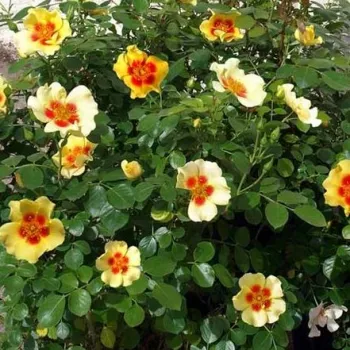
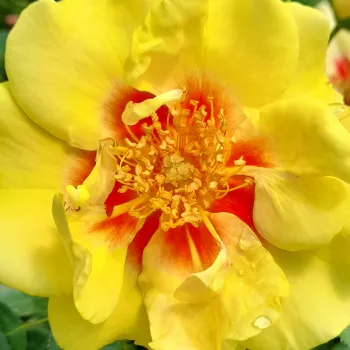
EYE OF THE TIGER – yellow bedding floribunda rose – Warner
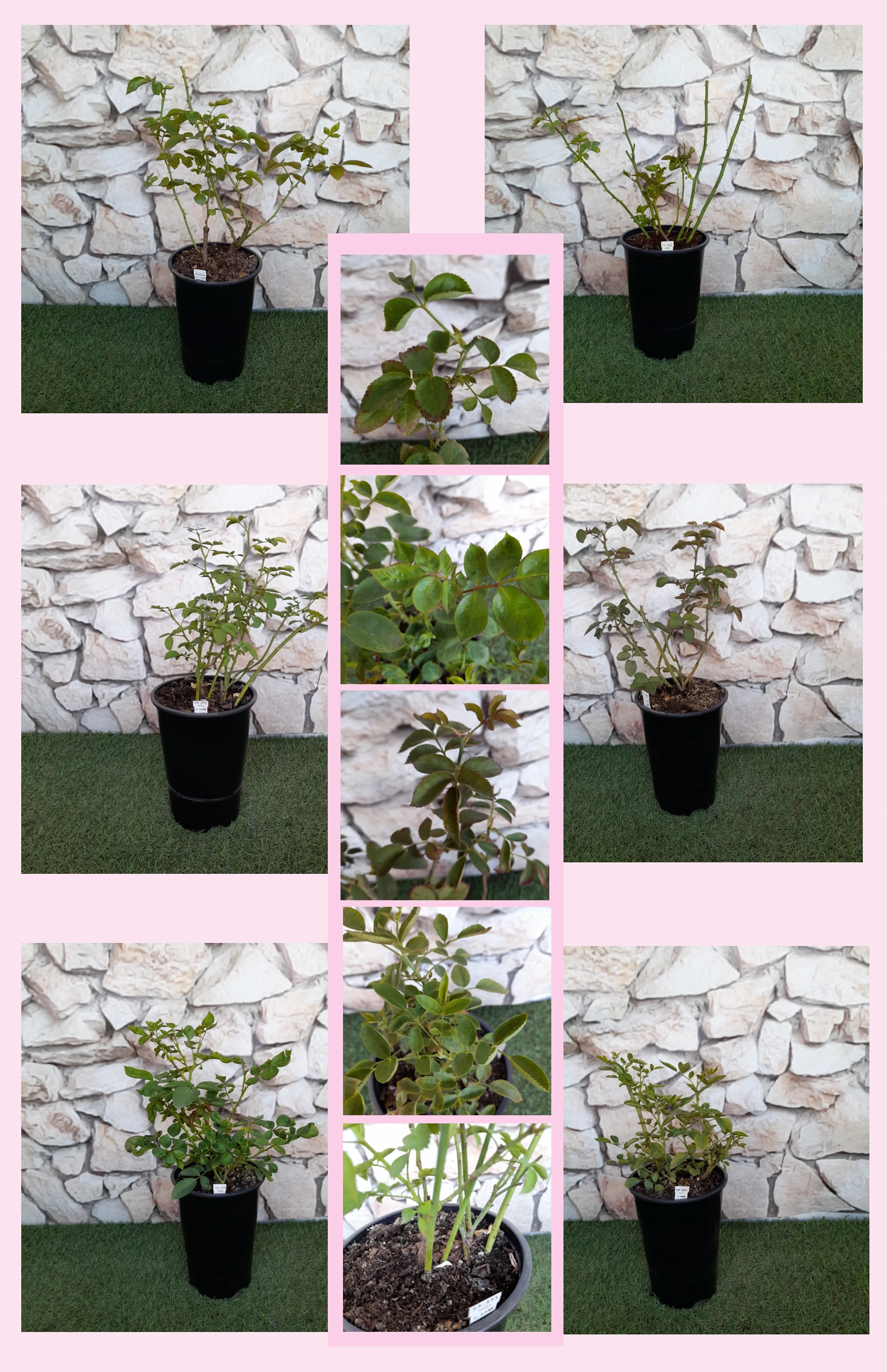
Bring a touch of storybook romance to your garden with Eye of the Tiger, a compact floribunda whose sunshine-yellow blooms and bold red eye create an instant cottage-garden focus. This own-root, 2-litre rose settles quickly and, with simple planting and light seasonal care, rewards you with generous, repeat-flowering colour from early summer into autumn. Its bushy, evenly rounded habit makes it easy to place in mixed borders, low hedges or large containers, while the open, single flowers are naturally wildlife-friendly, giving bees and other pollinators excellent access to pollen. The glossy mid-green foliage offers a tidy, modern backdrop to its playful bi-coloured blooms and copes well in typical British changeable conditions, even where breezes and showers roll in from the coast. Own-root plants build strength year by year, supporting an impressive long-term display with good capacity to regenerate from the base. Expect the classic pattern of firm rooting in year one, fuller top growth in year two and a truly mature garden presence by year three, with dependable rhythm of flowering that suits busy households who prefer enjoyment over effort.
Usage options
| Target area |
Reasoning |
| Front-of-border bedding in a family cottage garden |
The compact, bushy habit and 85–115 cm height make this rose ideal for front or mid-border planting where it forms a neat, textural mass. Repeating flushes of bright yellow flowers with a red eye create ongoing interest without complicated pruning, perfect for busy beginners. |
| Low informal hedge along paths or driveways |
Planted at the recommended 85 cm spacing, Eye of the Tiger forms a low, softly rounded hedge that guides visitors while staying within family-garden scale. Own-root growth gives long-lived structure that can be pruned hard or lightly trimmed as required by practical homeowners. |
| Statement specimen in a small lawn or gravel area |
Used singly at around 160 cm spacing, this floribunda becomes a striking focal point, its sunshine-yellow and carmine-red flowers standing out against simple lawn or gravel. The tidy, upright-bushy structure means no staking and minimal shaping, suiting style-conscious gardeners. |
| Large container on terrace, patio or balcony (40–50 L+) |
In a 40–50 litre or larger pot with good drainage, the dense root system stays stable and productive, giving a long season of blooms at eye level. Own-root resilience allows occasional harder renewal pruning after several years, an advantage for urban container-owners. |
| Pollinator-friendly mixed cottage border |
The simple, 5–12 petalled flowers leave stamens fully exposed, attracting bees and other beneficial insects throughout the season. Repeated flowering means a steady nectar and pollen resource, while the bright colour ring suits informal plantings created by wildlife enthusiasts. |
| Family play garden with relaxed maintenance |
Moderate disease resistance and self-cleaning flowers mean fewer deadheading and spraying rounds, while the bushy, rounded plant shape stays visually tidy. Own-root structure supports recovery if wayward footballs or pruning mistakes occur, reassuring family gardeners. |
| Coastal or breezy suburban gardens |
The dense foliage and relatively low, broad habit help the plant stand firm in exposed positions, while flowers and foliage cope with frequent showers and brisk winds common near the sea, including those gardens where rain and gusts regularly sweep in from the coastline. |
| Edging kitchen gardens and productive plots |
Eye of the Tiger works beautifully as a low edging around vegetable beds, its compact growth not overshadowing crops while attracting pollinators into the plot. The occasional decorative hips add late-season charm, appreciated by traditional allotmenteers. |
Styling ideas
- Cottage Edge – Line a path with Eye of the Tiger and interplant with soft blue Calamintha nepeta ‘Blue Cloud Strain’ for a humming, pollinator-friendly border – ideal for wildlife-minded family gardeners
- Kitchen Frame – Use this rose as a low hedge around raised vegetable beds, pairing with Gypsophila repens ‘Knuddel’ to echo the yellow and red flower centres – perfect for traditional kitchen-garden lovers
- Terrace Focus – In a 50 L terracotta pot, let Eye of the Tiger be the single focal plant by a seating area, underplanting with trailing thyme for fragrance – suited to busy urban balcony and patio owners
- Storybook Mix – Combine with old-fashioned pink and white roses behind, and a neat strip of Euonymus fortunei 'Minimus' in front, for a romantic, layered cottage-bed – great for fans of classic English countryside style
- Play-Safe Border – Place a loose row along the lawn edge where children play, relying on its solid, own-root structure and forgiving pruning needs – reassuring for practical, low-maintenance family households
Technical cultivar profile
| Parameter |
Data |
| Name and registration |
Floribunda bedding rose, registered as CHEwbullseye, marketed as Eye of the Tiger; exhibition category floribunda bush rose, part of the bedding rose collection for garden use. |
| Origin and breeding |
Bred by Christopher Hugh Warner, United Kingdom, from ‘Belting Pink’ × ‘Golden Age’; bred 2006, registered 2011, introduced 2015 via Pépinières de la Saulaie in France. |
| Awards and recognition |
RNRS Certificate of Merit St Albans 2014; Gold Standard Rose Trials Gold Standard 2015; First Prize Lyon Rose Competition 2015; Novelty and Public Awards in later international trials. |
| Growth and structural characteristics |
Bushy, shrub-like habit with dense, mid-green, glossy foliage; moderately thorny stems; height and spread typically 85–115 cm, forming a compact, rounded, bedding-friendly plant. |
| Flower morphology |
Single to semi-single cluster-flowered blooms, 5–12 petals, medium sized at roughly 4–7 cm across; flat flower form borne in clusters, remontant with a notably plentiful second flush. |
| Colour data and phenology |
Sunshine-yellow petals with a deep carmine-red central eye; ARS YB, RHS 14A outer, 53A inner; colour softens from bright yellow to buttery tones and rose-pink eye as blooms age. |
| Fragrance and aroma |
Soft, discreet fragrance of mild intensity, present but not overpowering; suitable for seating areas where visual impact and pollinator value are preferred over strong perfume. |
| Hip characteristics |
Occasional small hips, 6–9 mm, spherical and orange-red; form mainly after good pollination, adding minor late-season decorative interest without significant self-seeding concerns. |
| Resistance and winter hardiness |
Hardy to about −34 to −32 °C (USDA 4a, RHS H7); moderate resistance to black spot, powdery mildew and rust; tolerates heat reasonably but needs watering in extended dry spells. |
| Horticultural recommendations |
Best in full sun with well-drained soil; spacing 95 cm for mass bedding, 85 cm for hedging, 160 cm as specimen; suitable for large containers and urban planting with medium care needs. |
Eye of the Tiger offers vivid colour, compact structure and pollinator-friendly blooms in a resilient own-root form that matures gracefully over the years, making it a thoughtful, enduring choice for your cottage-style garden.