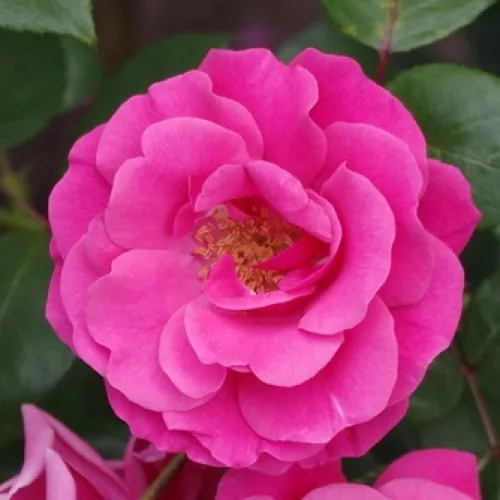
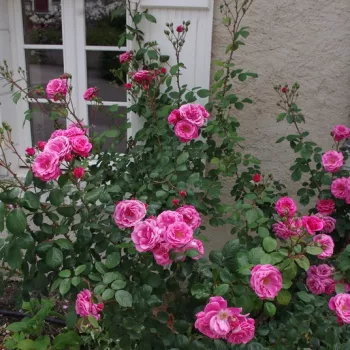
ÉTUDE – deep pink climbing rose - Gregory
Create a small, romantic retreat with Étude, a deep raspberry-pink climbing rose that brings a soft, romantic glow to walls, fences and arbours while coping well with cool, breezy conditions and typical British gardens where winds and rain can be frequent. Its sweet, long-lasting, raspberry fragrance turns a simple seating area into an afternoon-tea corner, and the moderately glossy dark green foliage frames the blooms for a true storybook cottage look. As an own-root plant, it offers reassuring longevity, quiet regeneration if stems are damaged, and reliable structure even after harder pruning. Over time, you can expect a gentle development arc from establishing roots in the first year, stronger shoots in the second, and full ornamental impact by the third year.
Usage options
| Target area | Reasoning |
|---|
| Arbour or pergola for afternoon tea |
Étude’s climbing habit and medium-sized, double, raspberry-pink flowers are ideal for clothing an arbour, bringing shade, scent and privacy to a small seating area and making relaxed weekend tea feel special for the romantic homeowner |
| Cottage-style front garden |
Its deep pink colour and classic cup-shaped blooms suit traditional brick or stone facades, softening doorways and windows while remaining in scale for typical UK front gardens that need charm without overwhelming the space for the traditionalist |
| Family fence or boundary screen |
The 1.8–2.6 m height and moderate spread help convert a plain fence into a floral backdrop, giving privacy and seasonal interest with manageable pruning tasks, even where time and gardening experience are limited for the busy family |
| Small urban terrace with large container |
In a 40–50 litre or larger pot with support, Étude offers vertical colour and fragrance where ground space is scarce, allowing you to enjoy a cottage-garden feel on a balcony or terrace without committing to a full planting scheme for the urban gardener |
| Part-shaded side passage or alley |
This climber tolerates partial shade, so it can brighten side paths that receive sun for only part of the day, giving an inviting, scented route between front and back garden rather than a purely functional corridor for the practical owner |
| Wall-trained feature near doors or windows |
Trained on horizontal wires, Étude’s sweet, raspberry scent and vivid blooms are best appreciated close to the house, where regular deadheading is easy and its moderate height suits typical two-storey walls for the scent lover |
| Country kitchen garden border |
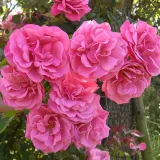
Among herbs and vegetables, its deep pink clusters and autumnal orange-red hips add colour and structure, fitting beautifully with cottage-style planting and giving a soft division between productive beds and lawn for the kitchen-gardener |
| Coastal or exposed family plot |
Étude can be trained securely to trellis or wires, creating a stable, anchored screen that copes with cool, breezy weather and frequent rain, offering dependable flowers once settled in despite less-than-sheltered positions for the coastal resident |
Styling ideas
- Cottage-arch – Train Étude over a simple metal or wooden arch, underplanting with lavender and catmint for a soft blue contrast – ideal for lovers of classic English cottage entrances
- Kitchen-border – Let this climber rise at the back of a kitchen garden bed, threading between obelisks of beans and clumps of chives for a homely, productive-romantic mix – suited to country cooks
- Pastel-screen – Pair Étude on a fence with pale pink roses and white gypsophila to create a gauzy, pastel privacy screen – perfect for small family gardens needing gentle seclusion
- Bold-contrast – Grow Étude with Crocosmia ‘Lucifer’ and lamb’s ear at its feet for a strong raspberry-red and silver foliage contrast – for gardeners who enjoy a slightly bolder cottage style
- Patio-arbour – In a large 50 litre container, guide Étude up a compact arbour beside a bistro set, with pots of herbs around the base – a good choice for terrace and courtyard owners
Technical cultivar profile
| Parameter | Data |
|---|
| Name and registration |
ÉTUDE – deep pink climbing rose - Gregory; ARS exhibition name Étude; large-flowered climbing rose in the climbing rose commercial group, sold as a darinaROSE ORIGINAL own-root plant. |
| Origin and breeding |
Bred by Charles Walter Gregory in the United Kingdom in 1965 from ‘Spectacular’ × ‘New Dawn’; introduced 1973 via C. Gregory & Son Ltd. in Great Britain and Roy H. Rumsey Pty. Ltd. in Australia. |
| Growth and structural characteristics |
Vigorous climbing habit, around 1.8–2.6 m high and 1.2–2 m wide, with moderately thorny shoots and moderately dense, slightly glossy dark green foliage; weak self-cleaning, so deadheading is recommended. |
| Flower morphology |
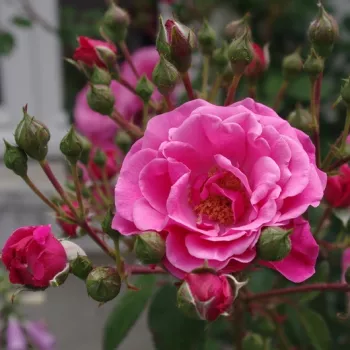
Medium-sized, double, cup-shaped blooms with 26–39 petals, produced mainly in clusters; remontant with a lighter second flush, giving waves of colour rather than continuous peak flowering through the season. |
| Colour data and phenology |
Deep raspberry-pink flowers with RHS 57C outer and 57B inner tones; colour fades gently to a warmer pink while remaining intense, with subtle silvery edges and good overall colour retention in garden conditions. |
| Fragrance and aroma |
Strong, sweet fragrance with a distinct raspberry character; scent is long-lasting on the plant, making it particularly rewarding where blooms are grown near seating areas, paths or frequently opened doors and windows. |
| Hip characteristics |
If not deadheaded, it can form moderately abundant, spherical orange-red hips about 10–14 mm across, adding late-season decorative interest and a gentle wildlife-friendly element to the planted structure. |
| Resistance and winter hardiness |
Hardy to around −21 to −18 °C (RHS H7, roughly USDA 6b; Swedish zone 3) but shows moderate susceptibility to powdery mildew and black spot and high rust sensitivity, so regular plant protection is advisable. |
| Horticultural recommendations |
Best trained on walls, fences or pergolas at 140–250 cm spacing; prefers good soil preparation and drainage, consistent watering in dry spells, and routine deadheading plus spray programmes where fungal pressure is high. |
ÉTUDE – deep pink climbing rose - Gregory offers romantic colour, strong fragrance and flexible training on walls or arbours, with the long-term reliability of an own-root plant, making it a thoughtful choice for enduring cottage-style schemes.