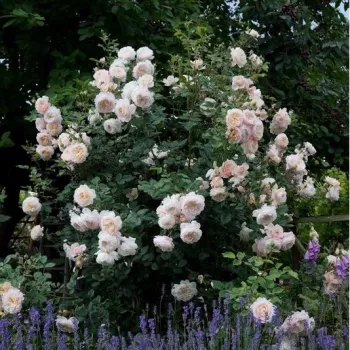
CROCUS ROSE – cream-coloured English rose - Austin
White-painted arbours, vintage china and soft petals set the scene for ‘Crocus Rose’, a romantic English shrub rose that slips easily into an informal cottage border without demanding complicated care. Its bushy habit and repeat-flowering nature bring reliable charm to average family gardens, even where breezy, wetter spells ask for planting in raised beds to improve drainage on heavy soils. Medium maintenance needs suit busy households, while own-root resilience promises a long-lived, regenerating structure that settles in steadily – roots in the first year, branching growth in the second, and a full, storybook display by the third summer.
Usage options
| Target area |
Reasoning |
| Front garden focal shrub |
Its bushy, 100–150 cm growth and dense, mid-green foliage create a soft yet substantial presence that frames a front path or bay window without overwhelming smaller plots; ideal for those wanting classic impact from a single, reliable rose for homeowners. |
| Cottage-style mixed border |
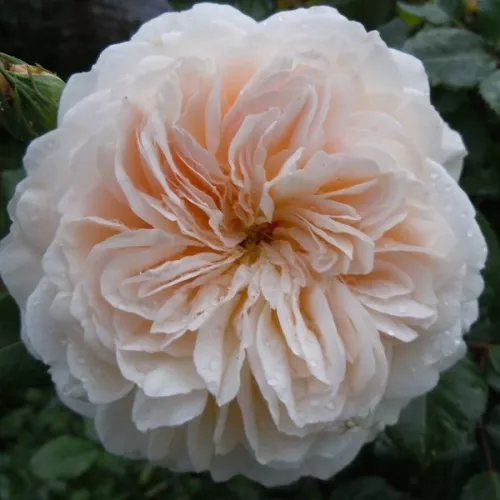
Very double, rosette flowers in cream and peachy yellow repeat through the season, weaving naturally among perennials and herbs to give that informal cottage look with only occasional deadheading and basic protection, suiting relaxed romantics. |
| Low, informal hedge |
Planted 90–100 cm apart, its even height and bushy habit form a loose hedge that softens boundaries or screens play areas, while own-root durability helps it recover from pruning or accidental knocks, reassuring practical families. |
| Near seating, terrace or arbour |
The medium, fresh fragrance carries pleasantly at sitting height without being overpowering, and the soft cream colouring flatters brick, timber and painted surfaces, making it a gentle companion for patios and arbours enjoyed by relaxed hosts. |
| Flower bed for continuous display |
Good repeat flowering with abundant second flushes keeps beds colourful well into late summer; moderate self-cleaning and simple pruning mean you mostly enjoy blooms rather than chores, well suited to time-pressed beginner gardeners. |
| Large containers and courtyard pots |
In a 40–50 litre or larger container with free-draining compost, its tidy, rounded habit and medium height give long-season colour where borders are limited, especially in urban courtyards and terraces used by busy city dwellers. |
| Partial shade situations |
Suitable for partial shade, it performs reliably where full sun is limited, such as east-facing fences or near taller shrubs, giving soft, luminous blooms that brighten corners of typical British gardens favoured by understated traditionalists. |
| Clay or exposed family plots |
Well-rooting own-root plants anchor firmly and respond well to being set into improved soil or raised beds, staying steady in wind and coping with cooler, wetter spells common in many regions, giving confidence to cautious new planters. |
Styling ideas
- Kitchen-garden border – Line a vegetable plot with ‘Crocus Rose’ underplanted with sage for soft structure and cutting stems – for cooks who enjoy gathering flowers and herbs together.
- Arbour retreat – Plant on each side of a seat arbour with garden pinks and dwarf heuchera at the feet for layered romance – for readers who savour quiet afternoon tea corners.
- Soft-front hedge – Create a low, informal hedge beside a path, mixing with small evergreen shrubs for year-round shape – for families wanting gentle privacy without harsh fencing.
- Courtyard containers – Use one rose per 50 litre pot with airy grasses or lavender at the base to keep care straightforward – for flat and townhouse owners with paved spaces.
- Cream-rose drift – Mass three to five shrubs in a loose triangle among cottage perennials to form a billowing focal area – for romantics planning a storybook-style garden view.
Technical cultivar profile
| Property |
Data |
| Name and registration |
Shrub rose from the English Rose Collection, registered as AUSquest; marketed as Crocus Rose and classified in the romantic rose group for garden and exhibition use. |
| Origin and breeding |
Bred by David C. H. Austin in the United Kingdom from ‘Golden Celebration’ × unknown parentage; introduced and distributed by David Austin Roses Ltd in 2000. |
| Awards and recognition |
Holds the Royal Horticultural Society Award of Garden Merit, indicating reliable garden performance and ornamental value under typical United Kingdom growing conditions. |
| Growth and structural characteristics |
Bushy shrub reaching 100–150 cm in height and spread, with dense, glossy mid-green foliage and moderate prickliness; overall habit is rounded and well filled from base to tip. |
| Flower morphology |
Large, very double, rosette-shaped blooms with over 40 petals, borne mainly in clusters; good repeat flowering ensures an abundant second wave after the first main flush. |
| Colour data and phenology |
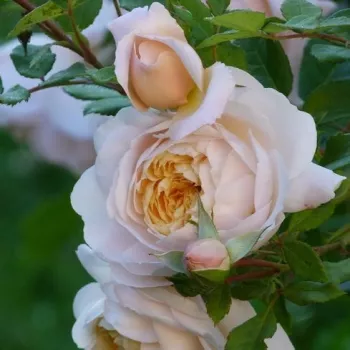
Soft cream-yellow flowers with peach tones inside; buds butter-yellow with peach-pink veils; colour fades in heat to pale cream, with RHS 158C outer and 14D inner references. |
| Fragrance and aroma |
Fresh, clean medium-strength scent that is clearly noticeable without being overpowering; double flowers and concealed stamens mean it serves chiefly as an ornamental rather than wildlife rose. |
| Hip characteristics |
Due to the very double flowers, hips are few; when present they are small, spherical, orange-red, around 9–15 mm in diameter and add a modest late-season accent. |
| Resistance and winter hardiness |
Hardy to approximately −26 to −23 °C (RHS H7, USDA 5b, Swedish zone 4); disease resistance is medium for black spot, mildew and rust, benefiting from standard protection. |
| Horticultural recommendations |
Suited to beds, edging, mixed shrub groups, specimen planting, parks and cutting; plant about 1–1.2 per m², allowing 90–180 cm spacing depending on hedge or specimen use. |
Crocus Rose offers romantic repeat flowering, a bushy family-friendly habit and durable own-root growth, making it a thoughtful choice for those planning a long-lived cottage-style rose feature.