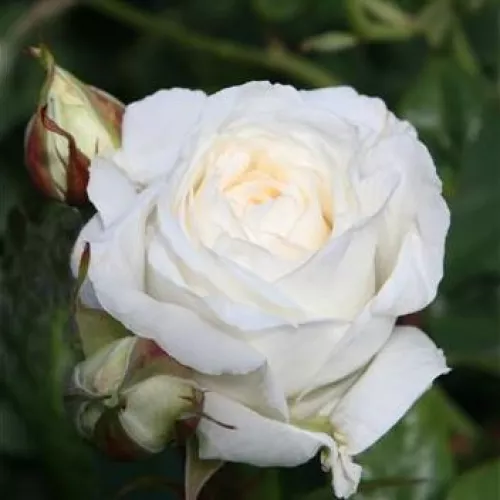
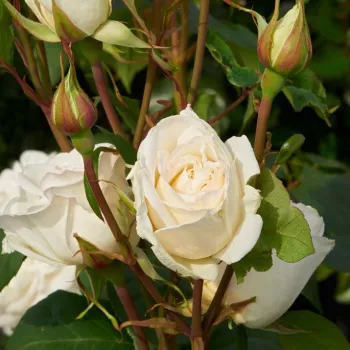
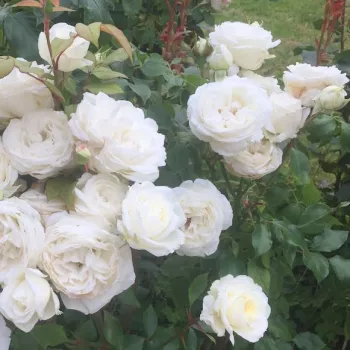
CLAUS DALBY™ – cream-white hybrid tea rose
If you dream of afternoon tea under a rose-covered arbour, CLAUS DALBY™ offers large, exhibition-style blooms in a soft cream-white that sit beautifully in a cottage border and as cut flowers. Its bushy habit and dense, glossy foliage make it easy to weave into a “girly” English country look while staying surprisingly manageable in an average family garden. In breezier plots it stands firm, anchored against the wind with a quietly elegant outline. The strongly honey-scented flowers are generously repeat-blooming, bringing romance and cosiness from early summer well into autumn. As an own-root plant it settles steadily, building a dependable framework over time for long-term longevity and reliable regeneration with minimal fuss, so you can enjoy the fragrance and refined colour without complicated routines.
Usage options
| Target area |
Reasoning |
| Feature rose near terrace or seating area |
The strong, honey-like perfume and large, high-centred flowers make this an ideal focal point close to where you sit for afternoon tea, giving you maximum enjoyment of the scent and colour with just occasional light pruning – perfect for the scent-loving homeowner. |
| Romantic cottage-style mixed border |
The bushy habit and dense, glossy foliage lend structure in a traditional cottage border, while the cream-white flowers blend softly with pastels and herbs; simple annual deadheading keeps repeat flowering going, with the plant gradually maturing into a long-lived framework for the relaxed cottage-gardener. |
| Cutting patch for home-arranged bouquets |
With long stems, very full hybrid-tea blooms and an exhibition flower form, this rose is superb for cutting and arranging in vases, allowing you to bring its fragrance indoors; a few well-placed plants will supply regular stems through the season for the creative flower-lover. |
| Specimen rose in a small or medium front garden |
Planted alone or as a small group, the erect, bushy shape and refined cream-white flowers offer a smart yet romantic look that suits traditional front gardens; straightforward winter pruning is all that is needed to maintain shape and flowering for the style-conscious town-gardener. |
| Large container (40–50 litre or more) on patio |
In a generously sized pot of 40–50 litres or more with good drainage, its moderate height and bushy habit stay in proportion, creating an elegant, movable feature for paved spaces; regular watering and feeding are easy to manage for the busy balcony-owner. |
| Own-root long-term planting in family garden |
As an own-root shrub, it forms its flowering framework gradually, building a resilient base that can regrow from below soil level after stress, helping it keep ornamental value for many years with simple care – well suited to the long-view planner. |
| Roses in exposed, breezier positions |
The bushy structure and firm growth habit mean it stands up well visually in gardens where wind is a factor, giving a composed appearance when paired with low hedging; deep planting and a modest mulch help stability for the weather-aware coastal-gardener. |
| Family garden beds with simple yearly routine |
This variety responds well to a single main prune in late winter and light deadheading after flushes, with reliable repeat bloom rather than high-maintenance grooming, making it easy to integrate into a garden where time is limited for the busy family-gardener. |
Styling ideas
- Tea-table focus – Position CLAUS DALBY™ by a seating nook with lavender and soft pink geraniums so the creamy blooms and perfume frame afternoon tea – ideal for the romantic entertainer.
- Cottage ribbon – Plant in a loose row along a path with foxgloves and catmint to create a storybook, cream-and-pastel ribbon of flowers – perfect for the cottage-border enthusiast.
- Elegant container – Grow in a 50-litre terracotta pot with trailing thyme at the rim to highlight the bushy shape and scent on a sunny patio – suited to the patio gardener.
- Cutting corner – Dedicate a small bed with CLAUS DALBY™, white cosmos and soft grasses, giving reliable stems for vases and a light, airy feel – appealing to the home florist.
- Calm frontage – Combine with low box or dwarf honeysuckle edging so the cream-white flowers sit above neat greenery, giving a composed, traditional first impression – ideal for the front-garden traditionalist.
Technical cultivar profile
| Characteristic |
Data |
| Name and registration |
Hybrid tea rose, registered as POUlht009, marketed as Claus Dalby™ Hybrid Tea POULSEN®; also exhibited as ‘Serenity’, belonging to the Hybrid Tea POULSEN® collection. |
| Origin and breeding |
Bred by Mogens Nyegaard Olesen, Poulsen Roser A/S, Denmark, from unnamed parents; bred in 2006 and introduced after 2013, with EU plant breeders’ right from 2013. |
| Awards and recognition |
Highly decorated for fragrance and garden value, including Tokyo gold medal for fragrance, several silver medals, audience fragrance award at Nantes, and a Paris certificate of merit in 2015. |
| Growth and structural characteristics |
Bushy, upright shrub 85–115 cm tall and 65–95 cm wide, with dense, dark green glossy foliage and moderate prickles; self-cleaning is weak, so spent blooms may need manual removal. |
| Flower morphology |
Large, very full, high-centred hybrid-tea blooms with more than 40 petals, mainly borne solitary on stems; remontant habit with a generous second flush, ideal for both beds and cutting. |
| Colour data and phenology |
Warm cream-white flowers, ivory in bud with buttery hints, opening to creamy white and fading towards soft snow-white while retaining a gentle warmth; medium colour retention across repeated flushes. |
| Fragrance and aroma |
Strong, long-lasting perfume with a honey-like character, best appreciated near seating or when used as cut flowers; double form and concealed stamens mean low value for pollinators. |
| Hip characteristics |
Hip production is limited because of very double flowers; when present, hips are spherical, orange-red, around 12–16 mm diameter, adding a modest autumn interest to established plants. |
| Resistance and winter hardiness |
Hardy to about –21 to –18 °C (RHS H7, Swedish zone 3, USDA 6b); moderate susceptibility to powdery mildew, black spot and rust, so standard preventative care is advised in humid regions. |
| Horticultural recommendations |
Best in sunny sites with fertile, well-drained soil; recommended spacing 55 cm for beds, 50 cm for low hedging and 90 cm for specimens, with moderate maintenance including pruning and occasional plant protection. |
CLAUS DALBY™ offers richly scented cream-white blooms, a bushy, easy-to-place habit and long-term stability from its own-root form, making it a thoughtful choice for gardeners seeking enduring, romantic structure.