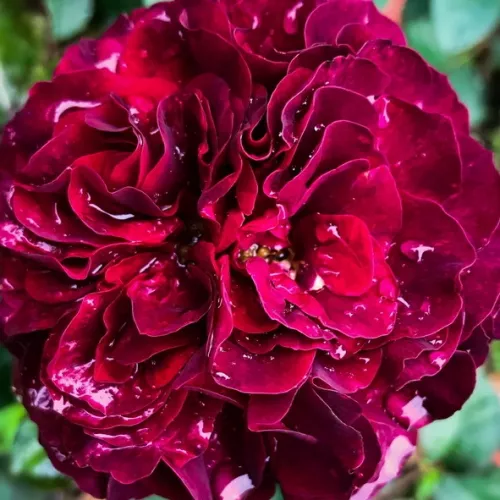
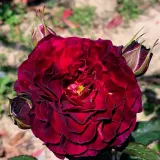
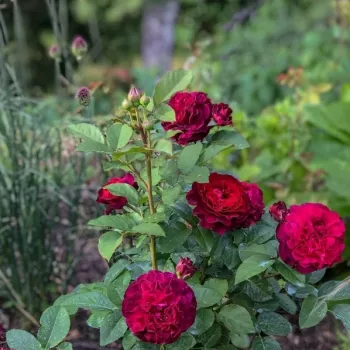
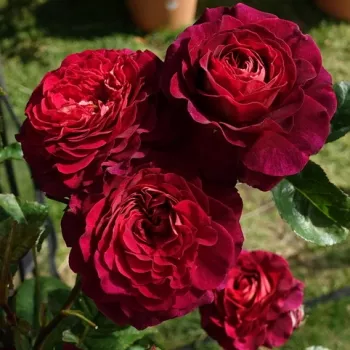
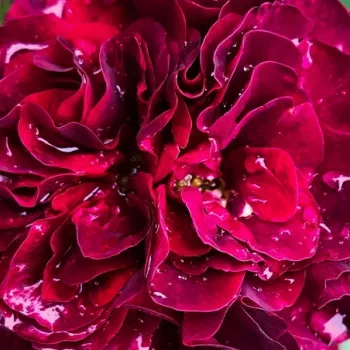
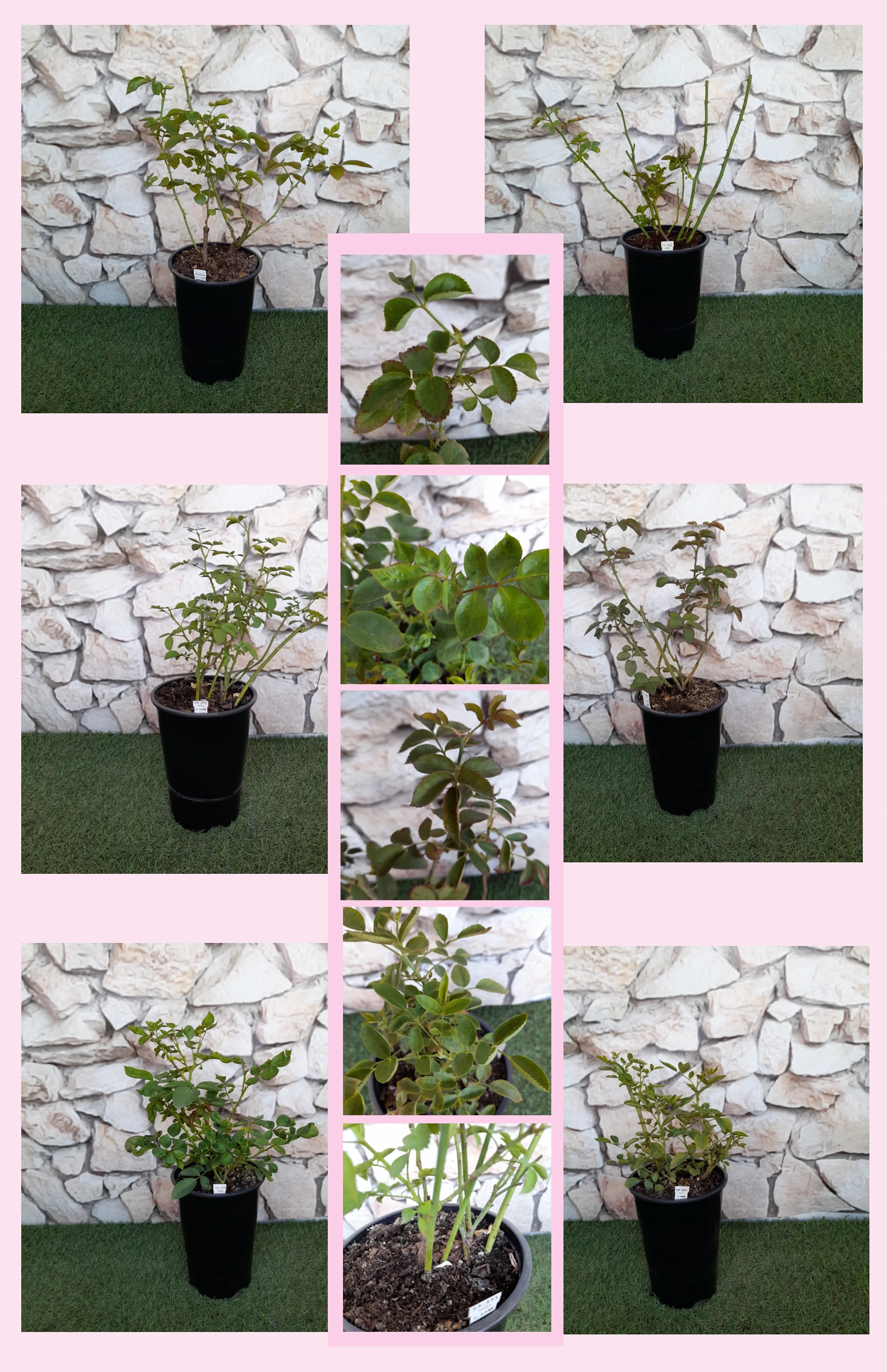
CHRISTIAN TETEDOIE – crimson bedding floribunda rose
With its velvety crimson flowers and upright, medium-tall habit, Christian Tetedoie creates a quietly romantic focus in beds and borders, ideal beside a seating area for afternoon tea under an arbour. Planted in well-prepared soil that copes with heavier clay by improving drainage, this rose settles into a relaxed cottage-garden picture, combining naturally with perennials and kitchen-garden edges. In its first seasons you will appreciate its reliable, remontant bloom and gently sweet perfume as part of a cosy family garden scene. As an own-root plant, it offers reassuring longevity, regenerating from its base and maintaining ornamental stability over many years with straightforward pruning options. Its floribunda character means generous clusters of rosette blooms that hold their colour well in sun and warm spells, while the moderately thorny stems give good structure for traditional cottage-style layouts.
Usage options
| Target area |
Reasoning |
| Cottage-style flower bed near a terrace or seating area |
The upright, medium height and generous flowering make this variety ideal for bringing a romantic, storybook feel right up to your terrace, where you can enjoy its gently sweet scent at close quarters; its own-root form supports long-term structure and dependable regrowth for relaxed family enjoyment – especially suited to the hobby gardener. |
| Mixed cottage border with perennials |
Dense, dark green foliage and rosette-shaped, very double blooms work beautifully with traditional cottage perennials, giving a refined yet natural look; the floribunda habit provides repeating flushes of colour that weave through the season without needing complicated shaping – appealing for the kitchen-garden owner. |
| Small rose hedge along a path |
The recommended closer spacing allows you to create a low hedge that frames paths or separates lawn from kitchen beds; its upright growth and moderate prickliness form a clear but not harsh line that matures reliably over the years from a stable own-root base – ideal for the family buyer. |
| Statement specimen in a key garden focal point |
Used as a standalone shrub, its deep crimson flowers and glossy foliage draw the eye, turning a simple corner or lawn island into a focal point that feels carefully designed; own-root planting supports a long lifespan so the feature improves rather than declines with time – reassuring for the homeowner. |
| Traditional bedding groups in front of evergreen shrubs |
Planted in small groups, the dark red blooms stand out against evergreen backdrops and benefit from improved airflow; repeat flowering through the season keeps the display active, while straightforward pruning back in winter is usually sufficient to maintain shape – convenient for the busy urban gardener. |
| Large container or half-barrel on a sunny patio |
In a 40–50 litre container with quality compost and regular watering, this rose offers an easy way to bring cottage-garden character to a paved space; its height and flower density give good impact from a single plant and the own-root system helps it recover well if growth is cut back – practical for the balcony or courtyard owner. |
| Sunny front garden with heavier soils |
In UK conditions with heavier soils, improving drainage or creating a slightly raised bed helps the plant establish, then its upright habit and repeat flowering provide long-lasting curb appeal; own-root growth supports gradual thickening and resilience after hard winters – well suited to the traditional front-garden lover. |
| Romantic border in regions with warm, dry summers |
Where summers are warmer and drier, its good tolerance of heat helps blooms hold both form and colour; with regular watering in prolonged dry spells and consistent disease protection, it remains an elegant, long-lived feature in a classic cottage border – appreciated by the romantic rose enthusiast. |
Styling ideas
- Arbour-border – Plant Christian Tetedoie on either side of an arbour entrance, underplant with peach-leaved bellflower and soft herbs, to frame a small “afternoon tea” corner – for romantic cottage-garden lovers.
- Kitchen-edge – Run a low hedge of this rose along the outer edge of a kitchen garden, pairing with honesty and low-growing herbs for a productive yet ornamental boundary – for rural kitchen-garden owners.
- Crimson-focus – Use a trio in a small island bed in front of evergreen shrubs, adding tawny daylilies for contrast and long-season warmth – for homeowners wanting a simple focal point.
- Patio-barrel – Grow a single plant in a 50 litre half-barrel with fine gravel mulch and companion pots of lavender, echoing an English country courtyard – for busy urban gardeners with limited space.
- Storybook-path – Line a curved path with closely spaced plants, interplanting with low catmint and alliums to soften edges and guide the eye – for families seeking a storybook-style garden walk.
Technical cultivar profile
| Parameter |
Data |
| Name and registration |
Christian Tetedoie – Les Provençelles collection floribunda shrub rose; registered as MASchrite, commercial bedding floribunda rose, ARS exhibition name Christian Tetedoie. |
| Origin and breeding |
Bred in France by Dominique Massad in 2016; parentage undisclosed. Introduced 2018 by Pétales de Roses with breeding work from Pépinières & Roseraies du Val de Loire. |
| Growth and structural characteristics |
Upright shrub to 120–160 cm tall and 60–90 cm wide, moderately thorny, with dense, glossy dark green foliage providing good coverage and a refined, formal bedding presence. |
| Flower morphology |
Very double, rosette blooms with over 40 petals in medium-sized clusters; remontant, with a particularly abundant second flush. Most spent blooms remain and need deadheading to maintain appearance. |
| Colour data and phenology |
Deep velvety crimson with subtle black undertone; buds blackish-purple. ARS colour code DR, RHS 187A outer, 187B inner. Colour holds in strong sun, fading slightly purplish without browning. |
| Fragrance and aroma |
Mild, softly sweet fragrance of classic rose character, noticeable at close range but not overpowering around seating areas. Primarily ornamental, with limited pollinator value due to very double blooms. |
| Hip characteristics |
Produces small numbers of spherical red hips, around 10–14 mm in diameter, adding discreet late-season interest without dominating the plant’s overall ornamental effect in beds and borders. |
| Resistance and winter hardiness |
Hardy to about –21 to –18 °C (RHS H7, USDA 6b, Swedish zone 3). Highly susceptible to black spot, powdery mildew and rust, so benefits from regular preventive plant protection and good airflow. |
| Horticultural recommendations |
Best in full sun, in well-drained but moisture-retentive soil. Spacing: 55 cm for mass planting, 45 cm for hedging, 85 cm for specimens. Needs regular pruning, feeding, watering and systematic disease management. |
Christian Tetedoie combines velvety crimson clusters, an upright, space-efficient habit and dependable own-root regrowth into a long-lived feature rose that rewards considered care; an attractive choice if you seek a refined cottage-garden presence.