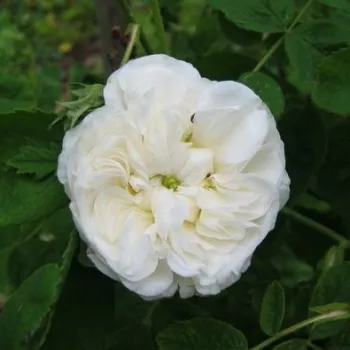
BOTZARIS – cream-white historic Damask rose - Robert
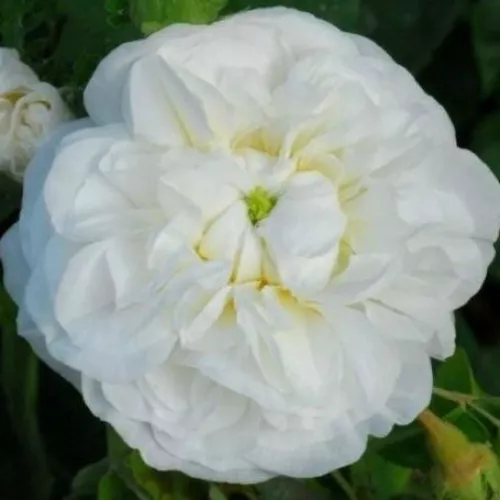
Step into a romantic, storybook atmosphere with the historic Damask shrub rose ‘Botzaris’, a bushy, slightly spreading rose that brings heritage charm and soft cream-white blooms to the family garden. Its once-a-year summer display of rosette, very double flowers is richly damask-scented, ideal for evoking afternoon serenity beside a seat or cottage path. As an own-root plant it offers reassuring longevity: if stems suffer from frost or pruning mistakes, it calmly regenerates from its own root system, preserving the original variety year after year. The cream-to-snow-white flowers hold their colour well, lighting up mixed borders in partial shade and setting off darker foliage beautifully. In typical British conditions it performs reliably when planted with good drainage and mulching, even where humidity tests disease resistance and long, damp spells are common. Use it for loose hedges, smaller park-style groupings or as a nostalgic specimen by the lawn for quietly enduring structure. Over time you can expect a natural development: firming roots in year one, stronger shoots in year two and full ornamental presence from about year three. With moderate care – seasonal pruning, watering in dry spells and some deadheading – this historic rose repays your attention with years of fragrance and character in an easy-going, cottage-style planting.
Usage options
| Target area | Reasoning |
|---|
| Cottage-style focal shrub near a seating area |
The bushy, slightly spreading habit and once-a-year flush of rosette blooms create a concentrated period of strong damask fragrance, perfect beside a bench or terrace where the scent can be enjoyed up close in a romantic setting – ideal for tea-lovers |
| Traditional mixed border in a family garden |
Its medium height and cream-white to snow-white flowers with good colour retention make it a useful structural shrub in mixed borders, weaving heritage character between perennials and herbs without dominating the space – suited to homeowners |
| Informal flowering hedge along paths or boundaries |
Planting at 90–100 cm centres allows ‘Botzaris’ to knit into a loose, traditional hedge, its moderately dense foliage and once-seasonal flowering giving a soft, storybook boundary that fits rural and village-style plots – attractive for families |
| Specimen rose in a small lawn or courtyard |
As a stand-alone shrub at around 105–155 cm high, this rose holds its own as a focal point; the historic Damask character and bottle-shaped orange-red hips add quiet winter interest once the flowering show has passed – appealing to collectors |
| Part-shade planting near walls or mature shrubs |
Its suitability for partial shade means you can place it where many modern roses struggle, for example on the east side of a house or among light shrubs, softening awkward corners while still producing a rewarding summer display – helpful for beginners |
| Raised beds and borders with improved soil |
Planting in raised beds or well-prepared borders supports root health and moderates moisture in regions prone to lingering damp, so the shrub maintains its medium disease resistance and stable framework with straightforward seasonal care – reassuring for busy-gardeners |
| Large containers on patios or cottage-style terraces |
In a generously sized container of at least 40–50 litres, its moderate height and bushy habit adapt well, letting you enjoy historic charm and fragrance on patios while the own-root system provides long-term resilience if top growth is cut back – perfect for urbanites |
| Low-maintenance, long-term planting schemes |
Once established as an own-root shrub, ‘Botzaris’ offers a lasting framework with only moderate maintenance: occasional plant protection, deadheading and pruning keep it attractive even where moist, breezy weather challenges roses – suited to time-poor |
Styling ideas
- Cottage-Hedge – thread ‘Botzaris’ along a front-garden boundary with lavender and catmint underplanting for a soft, scented hedge – for families who favour a welcoming, traditional frontage
- Tea-Corner – place a single shrub beside a bistro set, adding foxgloves and hardy geraniums for a relaxed afternoon-tea nook – for homeowners creating a cosy seating spot
- White-Border – combine its snow-white blooms with white campanulas, astrantias and silver foliage for a calm evening border – for those who enjoy restrained, elegant planting
- Kitchen-Path – line the way to a kitchen garden with ‘Botzaris’, herbs and low box or thyme edging to blend ornament and practicality – for cottage-garden enthusiasts
- Courtyard-Pot – grow it in a 50-litre terracotta pot with trailing thyme and violas to bring heritage charm to paved spaces – for urban gardeners short on beds but rich in taste
Technical cultivar profile
| Property | Data |
|---|
| Name and registration |
Historic Damask shrub rose marketed as BOTZARIS – cream-white historic Damask rose - Robert; American Rose Society exhibition name ‘Botzaris’; unregistered cultivar in heritage rose collections. |
| Origin and breeding |
Bred by François André Robert, Pépinières Robert, Angers, France; introduced in 1856 as a historic Damask–Hybrid Gallica type; parentage undocumented, preserved through traditional propagation as a heritage rose. |
| Growth and structural characteristics |
Bushy, slightly spreading shrub 105–155 cm high and 75–125 cm wide with moderately dense, dark green foliage, densely thorned stems and a stable outline suitable for hedging, beds and specimen planting in family gardens. |
| Flower morphology |
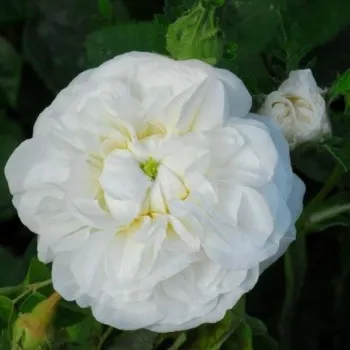
Medium-sized, very double rosette blooms with 40+ petals, borne mainly singly; a once-flowering, non-remontant variety providing one abundant summer flush, with poor self-cleaning so spent blooms benefit from manual removal. |
| Colour data and phenology |
Cream-white buds with pinkish tint open to white-cream flowers with pale lemon-yellow centre (RHS 155D outer, 11D inner), ageing to uniform snow-white; colour holds well, though petals may scorch slightly in intense sun. |
| Fragrance and aroma |
Classic Damask perfume, strong and long-lasting during peak flowering; intensely scented blooms ideal for enjoying near seating, entrances or paths, although fully double form limits pollen access and is mainly ornamental rather than for pollinators. |
| Hip characteristics |
Forms orange-red, bottle-shaped hips only occasionally, around 14–22 mm diameter; hips add a discreet seasonal accent but are not a dominant decorative feature and should not be relied upon for heavy autumn display. |
| Resistance and winter hardiness |
Hardy to approximately −32 to −29 °C (RHS H7, Swedish zone 5, USDA 4b); medium resistance to black spot, mildew and rust; tolerates heat and moderate drought only briefly and benefits from watering during prolonged dry spells. |
| Horticultural recommendations |
Best in well-drained, improved soil with mulching and regular watering in dry weather; suitable for beds, hedges, parks and cutting; medium maintenance with occasional plant protection and deadheading to maintain tidy, refined appearance. |
BOTZARIS – cream-white historic Damask rose - Robert offers rich fragrance, reliable shrub structure and resilient own-root growth for long-term enjoyment; an excellent choice if you appreciate quietly romantic roses with heritage charm.