Miniature (dwarf) roses

04-003-1
04-003-2

Baby Masquerade®

Mini - dwarf rose

TANbakede – Mathias Tantau Jr.

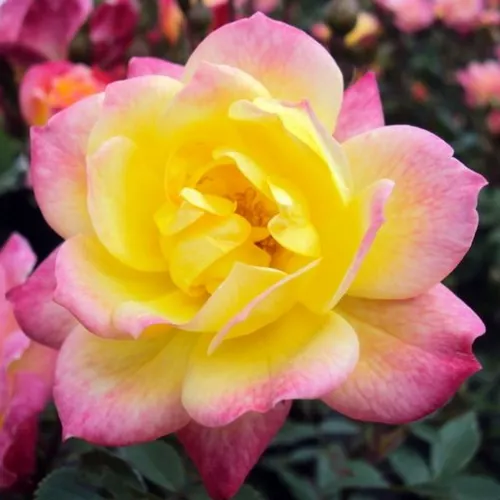
Golden-yellow base colour with a pink–red edged band that gradually deepens. - dwarf - mini rose - very weak, barely perceptible scented rose - fragrance description not available

– Cheerful yellow‑pink flowers in changing shades
– Compact bushy habit for beds and pots
– Dense, glossy dark green foliage effect
– Reliable remontant flowering through the season
– Hardy to about −20 °C, medium disease resistance
Special feature: Miniature version of the classic ‘Masquerade’, ideal for elegant small‑scale plantings.
Long lifespan – Elegant spaces
Baby Masquerade®
darinaROSE® ORIGINAL 2-litre own-root potted rose
21,20 £
Unfortunately, we are currently unable to ship to the United Kingdom; we only deliver to countries within the European Union. For more information, please contact us!
5 (8514)
facebook   twitter

BABY MASQUERADE® – yellow-pink dwarf mini rose - Tantau

Bring storybook romance into even the smallest garden with BABY MASQUERADE®, a compact miniature rose whose flowers shift from golden yellow to rose-pink as they mature, echoing the charm of an afternoon tea arbour in cottage borders and pots. Its bushy habit and dark glossy foliage give a tidy, well-kept look with modest effort, ideal where breezy, damp weather can challenge less resilient plants along exposed, rain-swept fences. Regular repeat flowering in cheerful clusters makes this a reliable choice for busy households wanting colour without constant fuss, while medium disease resistance supports easy-going care in typical British conditions. Own-root production promotes long-term stability, so plants can regrow well after harder pruning or weather damage and maintain their ornamental value over many seasons. Its dwarf height suits front-of-border ribbons, informal low hedges or large containers of at least 40–50 litres, where it anchors paths and seating areas without overwhelming the space. Partial-shade tolerance means you can slip it into real-life corners between sheds, veg beds and play spaces, gaining a soft cottage feel even where sun is limited. In its first years it settles in steadily – roots establishing in year one, top growth building in year two, and full garden presence by year three overall.


Usage options

Target areaReasoning
Front-of-border cottage edging The low 40–50 cm bushy habit forms a neat, colourful edging along paths and beds, perfect for cottage-style planting where you want structure without tall stems flopping into walkways. Clustered, continuously changing yellow-to-pink blooms create a lively ribbon of colour that feels playful yet ordered in a family garden setting, with maintenance limited mostly to light seasonal pruning and the occasional check for black spot and rust, suiting beginners.
Low informal flowering hedge Regular repeat flowering and dense foliage allow short hedges at 25–30 cm spacing, giving a soft boundary between lawn, play areas and kitchen beds without needing constant clipping. The semi-double flowers change colour as they open and fade, giving the impression of several varieties in one row, while the own-root form supports regeneration if sections are cut back harder after winter or accidental damage, reassuring families.
Large patio containers and tubs The compact spread and height make this rose easy to manage in substantial containers of 40–50 litres or more, where the root system has enough space to stay healthy for the long term. In pots on patios or balconies, the cheerful colour shifts are especially noticeable at close range, bringing seasonal interest around outdoor seating with simple care: regular watering, a yearly feed and light spring pruning are generally sufficient for busy-owners.
Small urban gardens and courtyards This dwarf-miniature type gives true rose character where ground is limited, while its bushy structure visually anchors beds beside paved areas, bins or sheds. In tight spaces you benefit from its own-root longevity: even if you re-shape or move the plant, it recovers reliably without the graft problems sometimes seen in older roses. Medium disease resistance matches the realities of built-up, humid locations, appealing to town-dwellers.
Mixed cottage and kitchen garden beds Baby Masquerade sits comfortably among herbs, salad crops and traditional perennials, its modest size ensuring it never overshadows lettuces, peonies or verbena. The flowers’ semi-double form provides at least some resource for insects while keeping the classic rose look, and the long-lived own-root structure fits beds that are replanted around it over many years by cottage-lovers.
Partially shaded side borders Suitable for partial shade, this rose copes with those common British side beds that receive only half a day of sun because of fences or neighbouring houses. Flowering remains reliable enough to justify a place where other sun-demanding varieties may disappoint, adding warmth and movement where utility paths, washing lines or sheds could otherwise dominate, which particularly helps homeowners.
Exposed, wind- and rain-prone spots The compact, bushy framework and relatively low centre of gravity help it stand up to breezy, damp conditions where taller roses may rock or break, providing colour and structure along open fences or at the front of raised beds in showery coastal-style weather with frequent wind-driven rain, reducing worry for coastal-gardeners.
Long-term family planting schemes With its own-root form and good hardiness, this miniature is a strong candidate for planting plans expected to mature over many seasons, such as front gardens or children’s beds that will slowly gain character. The plant follows a natural trajectory as it settles in, starting with root establishment, building more branching shoots, then reaching its full ornamental contribution over the first three years, suiting patient planners.

Styling ideas

  • Teacup-border – Line the front of a cottage-style border with Baby Masquerade, threading between lavender and catmint to echo its yellow-to-pink colour shifts – for romantic-border enthusiasts.
  • Patio-theatre – Group several large terracotta pots (40–50 litres) each with a Baby Masquerade, underplanting with trailing thyme and white alyssum for a scented, easy-care patio display – for balcony and terrace users.
  • Kitchen-ribbon – Create a low flowering strip between vegetable beds, combining Baby Masquerade with chives and marigolds for structure, colour and a gently traditional look – for kitchen-garden keepers.
  • Storybook-hedge – Form a short hedge along a front path at 25–30 cm spacing, mixing in dwarf box or low honeysuckle for evergreen backing behind the changing rose colours – for classic-front-garden fans.
  • Children’s-corner – Plant a small cluster in a sunny-to-part-shade play area, surrounding with peonies and tall verbena so children can watch the roses change colour through the season – for family-focused gardeners.

Technical cultivar profile
ParameterData
Name and registration Miniature rose marketed as BABY MASQUERADE®, with registered names Baby Masquerade, TANbakede and TANba; exhibition miniature category; part of the mini – dwarf rose collection.
Origin and breeding Bred by Mathias Tantau Jr. in Germany from Tom Thumb × Masquerade; breeding year 1955, introduced by Rosen Tantau in 1956; unregistered as a formal cultivar name.
Growth and structural characteristics Bushy dwarf shrub reaching about 40–50 cm high and 35–45 cm wide, with dense, dark green glossy foliage and moderate prickliness; forms a compact, well-branched miniature bush.
Flower morphology Semi-double blooms with roughly 13–25 petals, small in size (about 0.5–1.5 in), carried in clusters on short stems; flowers open fairly flat, giving colourful, easily visible heads.
Colour data and phenology Golden-yellow base with pink-red edging (RHS 14B and 46A); buds lemon-yellow with pink tinge, maturing through rose-red tones; colour retention modest, with noticeable fading as blooms age.
Fragrance and aroma Fragrance is very weak and barely perceptible, so this variety is chosen for its colour effect and compact habit rather than scent; semi-double form offers moderate interest to visiting insects.
Hip characteristics Produces moderate numbers of small spherical hips, around 4–6 mm across, coloured orange-red (RHS 44A); ornamental interest is subtle rather than dominant in the autumn garden.
Resistance and winter hardiness Hardy to around −21 to −18 °C (RHS H7, Swedish zone 3, USDA 6b); medium overall disease resistance with good mildew tolerance but only moderate resistance to black spot and rust.
Horticultural recommendations Best as border, bedding or pot plant at 25–45 cm spacing; grows in sun or partial shade with medium maintenance, requiring occasional protection from black spot and rust in damp seasons.

BABY MASQUERADE® offers compact, bushy colour changes, reliable repeat flowering and long-term own-root resilience, making it a thoughtful choice for relaxed cottage-style family gardens.
Detailed product attributes

Product Identification Data

Product Name: BABY MASQUERADE® – yellow-pink dwarf mini rose - Tantau
Product Type: darinaROSE® ORIGINAL - 2-litre own-root potted rose
Cultivar Authenticity: Verified:14.06.2025
Cultivar Quality Rating: premium bronze
Item Number: [334] 04-003 (14.02.2026) darinarose.co.uk

Name and Registration

Meaning of Cultivar Name: The trade name "Kis Álarcosbál" refers to the colour variation and denotes the miniature form of the large-flowered 'Masquerade'.
Cultivar Synonym: Baby Carnival; Baby Carnaval; Baby Mascarade; Baby Maskarade; Baby Maskerade
Registered Cultivar Name: Baby Masquerade; TANbakede; TANba
Original Trade Name: Baby Masquerade
Current Trade Name: Baby Masquerade® Mini - dwarf rose Baby Masquerade; TANbakede; TANba
Rose Group: Miniature
Commercial Type: dwarf - mini rose
Commercial Group: Mini - dwarf rose
Exhibition Category: exhibition miniature rose
Collection: Mini - dwarf rose

Origin and Breeding

Initial Distributor: Rosen -Tantau (Germany); Tantau Roses (Germany)
Introduction Year: 1956 (Germany)
Registration Year: unregistered cultivar
Breeder: Mathias Tantau Jr.
Breeding Company / Institution: Tantau Roses (Germany)
Breeding Year: Germany, 1955
Parentage: Tom Thumb (miniature, de Vink, 1936) × Masquerade (floribunda, Boerner, 1949)

Growth and Structural Characteristics

Height: 1.3-1.6ft (40-50 cm)
Spread: 1.1-1.5ft (35-45 cm)
Growth Habit: bushy
Foliage: The variety has dense foliage, with glossy leaves in a dark green hue.
Prickliness: moderately thorny
Self-Cleaning Description: No data available on self-cleaning.
Self-Cleaning Intensity: No data on self‑cleaning strength.

Flower Morphology

Petal Count: 13-25
Flower Fullness: semi-double
Flower Shape: flat
Flower Size: S (0,5-1,5 in)
Inflorescence Type: cluster-flowered
Colour Code: ARS code: YB RHS code: 14B (outer), 46A (inner)
Repeat Flowering: It is remontant and its second flowering is also abundant.

Colour Data and Phenology

Colour: yellow - pink
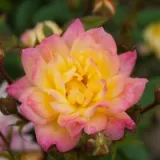
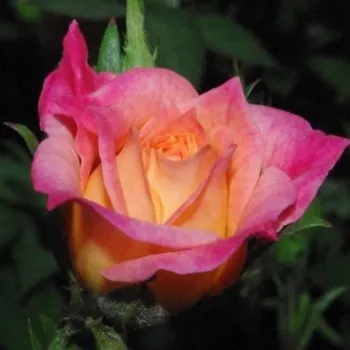
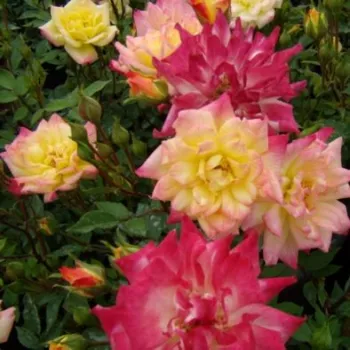
Flower Colour Description: Golden-yellow base colour with a pink–red edged band that gradually deepens.

Closed Bud: Bright lemon yellow with a subtle pink tinge.
Newly Opened Flower: Clear sun-yellow centre with a pale pink edge.
Full Bloom: The yellow ground colour fades, the edge brightens to carmine red.
Before Fading: A rose‑red tone predominates, with the yellow only subtly showing.
Colour Fading Description: The flowers change from yellow to pinkish‑red during opening.

Fragrance and Aroma

Fragrance Strength: very weak, barely perceptible scented rose
Fragrance Character: fragrance description not available
Pollinator Attraction: Semi-double flowers with 13–25 petals moderately attract pollinators, as the semi-double form and reduced accessibility of the stamens limit nectar and pollen access.
Pollinator-Friendly Rating: Due to its semi-double flowers, it can be regarded at best as partially pollinator-friendly.

Hip Characteristics

Hip Shape: spherical
Hip Colour: orange-red (RHS 44A)
Hip Comment: Moderately abundant, spherical rose hips, 4–6 mm in diameter, orange-red (RHS 44A).

Resistance and Hardiness

Hardiness (°C): -21–-18 °C
Heat and Drought Tolerance Description: No data are available on heat–drought tolerance.
Disease Resistance: medium
  • powdery mildew – resistant
  • black spot – medium
  • rust – medium

Horticultural Recommendations

Recommended Planting Distance: for mass planting 30 cm, for hedging 25 cm, as a specimen 45 cm
Planting Density: square planting 12,8 plants/m², hexagonal arrangement 14,7 plants/m²
Partial Shade Tolerance: suitable for partial shade
Maintenance Requirement: Maintenance requirement medium; occasional plant protection may be necessary, particularly against black spot and rust.
Primary Uses: border, pot, bed

Comments

Strengths: Long lifespan – Elegant spaces
Companion Plants: Paeonia lactiflora - fragrant peony Lonicera nitida ‘Maigrün’ - groundcover honeysuckle Verbena bonariensis - tall verbena
Comment: -
BABY MASQUERADE® – yellow-pink dwarf mini rose - Tantau
Golden-yellow base colour with a pink–red edged band that gradually deepens. - dwarf - mini rose - very weak, barely perceptible scented rose - fragrance description not available

Online rose order - dwarf - mini rose - Baby Masquerade® - yellow  - pink - (1.3-1.6ft (40-50 cm))
Inflorescence: cluster-flowered Height: 1.3-1.6ft (40-50 cm) Flower shape: flat Winter hardiness: - yellow - pink - Rosen -Tantau (Germany); Tantau Roses (Germany) dwarf - mini rose - Flower size: S (0,5-1,5 in) Flower size: S (0,5-1,5 in) - Height: 1.3-1.6ft (40-50 cm) Height: 1.3-1.6ft (40-50 cm) - Flower fullness: semi-double Baby Masquerade® - Roses in the garden | darinaROSE® Original - premium bronze Mathias Tantau Jr.

We showcase the external appearance of the roses available for online purchase from our webshop.


Which product type is right for you?


Information

In what condition do we send the rose from our online webshop?

Let us ask ourselves the question: What do I want to use the rose for?
Flower? - Location? - Cover? - Fragrance? - Height? - Breeder? - Rose hips?

Rose purchase information
Methods of payment - Delivery charges - Delivery - Complaints handling

Care guide

Our product is a rose grown with pharmaROSA®’s unique cultivation technology!

2-litre, own-root, potted rose.
With a shoot system appropriate to the season.
With a root system that thoroughly permeates the growing medium.
Quality compliant with the requirements of the E.N.A. (European Nurserystock Association).
Supplied in unique packaging that prevents damage.
Can be planted during frost-free periods.
True-to-variety rose bush with a unique identifier.

The pharmaROSA® own-root potted rose is a well-rooted plant that supports reliable establishment when planted and cared for properly, so it can be planted whenever the soil is not frozen.


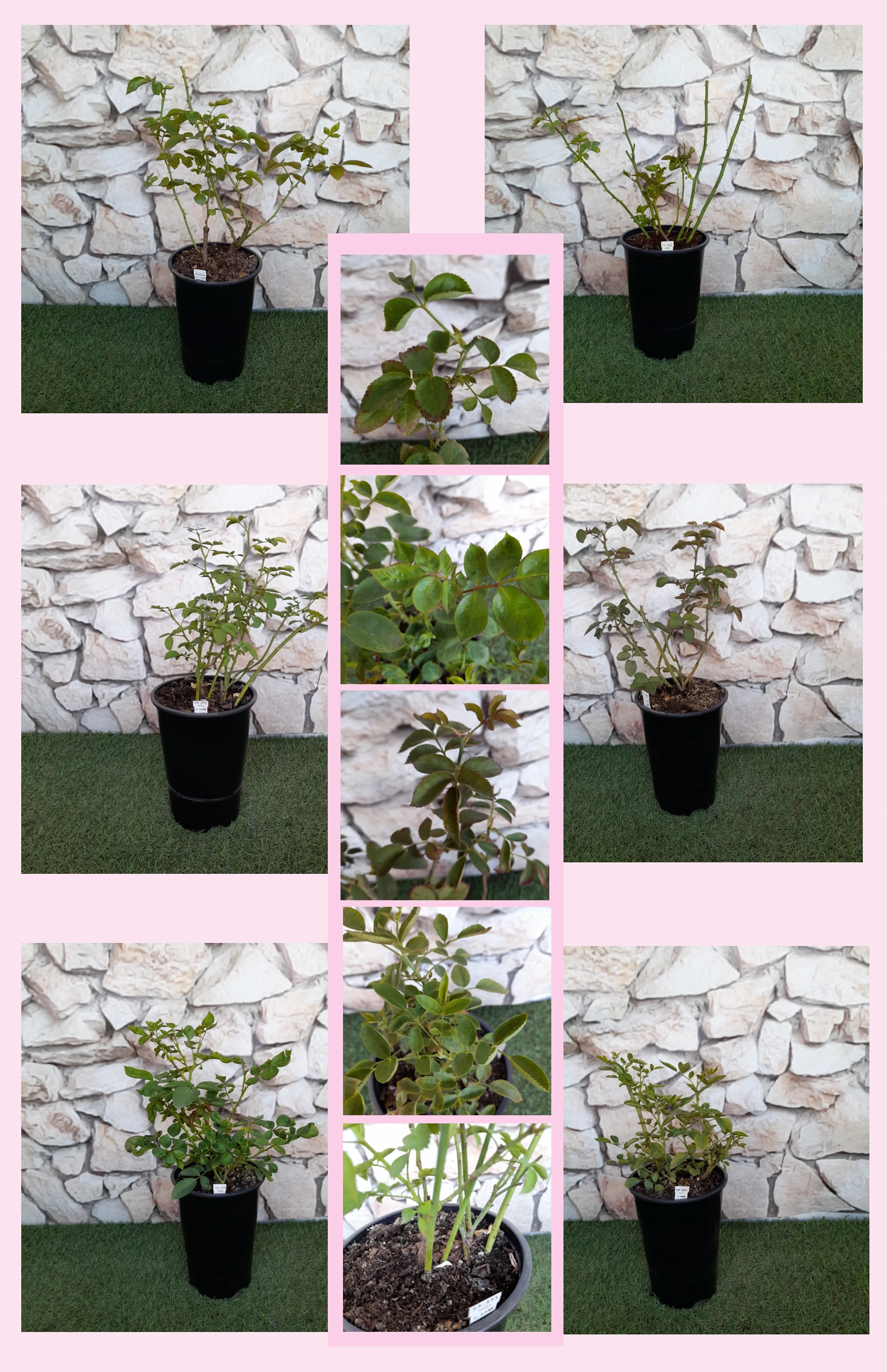
Crop overview: several varieties and growth stages in a short crop section.
Shoot system: intensive growth of fresh basal shoots on a young plant.
Root system: demonstration of a vigorous root system permeating the growing medium, by removing the pot.
Balance: mature plant with root system and shoots in harmony with each other.

Information about the videos
The video series is not a “seasonal showcase”; it illustrates the essence of pharmaROSA® own-root cultivation in a tangible way: how the plant is built up, what the root system is like and how the shoot system regenerates. The recordings were therefore made at different times and with plants at various stages of development, so mixed foliage levels and differing stages of growth may appear in the videos. They are not a ‘sample’ of the batch dispatched, but a visual explanation of how the technology works. The current condition of the rose available to order — typical for the given period and similar to what you can expect to receive in the parcel — is shown in the upper part of the product page.

pharmarosa.compharmarosa.depharmarosa.skpharmarosa.ropharmarosa.co.ukpharmarosa.sipharmarosa.czpharmarosa.atpharmarosa.hrpharmarosa.itpharmarosa.frpharmarosa.plpharmarosa.nlpharmarosa.espharmarosa.bepharmarosa.iepharmarosa.lupharmarosa.dkpharmarosa.grpharmarosa.sepharmarosa.lvpharmarosa.bgpharmarosa.fipharmarosa.eepharmarosa.ltpharmarosa.rupharmarosa.pt

Product types

Pages for private customers
Garden roses for the family garden, with minimal care  → ORIGINAL®
Premium garden roses – instant impact, a truly showpiece garden  → EXTRA®
Pages for professionals and private customers
Roses for public spaces – large areas, sustainable maintenance  → NATURAL®
Roses for projects – hedge and row planting, fast implementation  → RAPID®
For professional partners only
Production – propagation material for garden roses, wholesale  → NEONATAL®

Company details

PharmaRosa Ltd.
Company registration number: 01-09-717479
VAT number: 13075314-2-43
Plant health registration no.: HU130721
Bank account (IBAN):
HU85117631891388688400000000
BIC (SWIFT): OTPVHUHB
Bank name: OTP Bank Nyrt.