ANNELIES – pale pink park rose - Lens
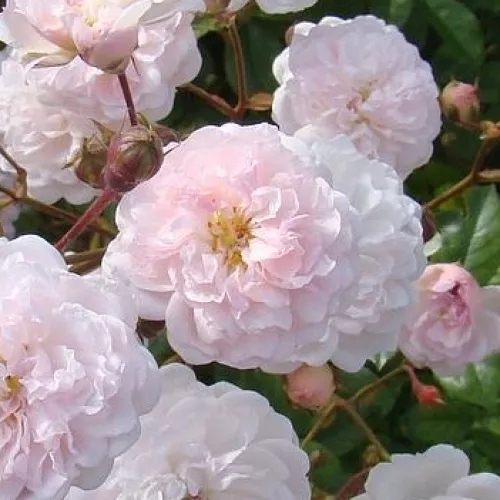
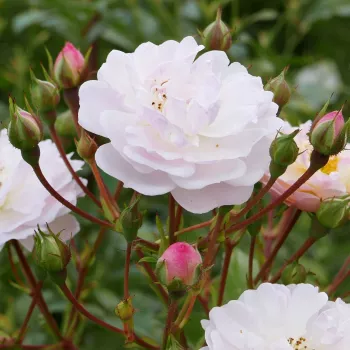
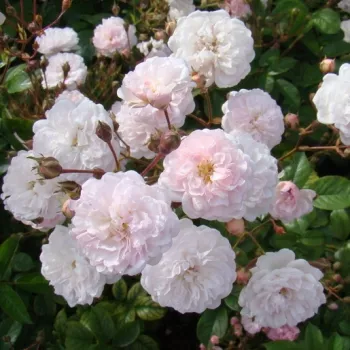
Romantic clusters of pale pink rosettes transform ordinary borders into storybook scenes, bringing a soft, cottage feel to family gardens without demanding expert care. This upright yet compact shrub reaches around 120–170 cm, ideal for informal hedges, arches or as a gently vertical accent among herbs and perennials. Bushes build up steadily as an own-root plant, giving reassuring longevity and the ability to regenerate from the base if winter or pruning are more severe than planned. Across the warmer months, it repeats its flowering in abundant, clustered waves, each bloom a small, very double rosette that opens powder pink then softly fades toward cream-white. This makes it easy to match with other pastels in a “girly”, English countryside style. The pharmaROSA® ORIGINAL 2-litre container gives you a well-started plant you can set out whenever the soil can be worked, with roots that anchor securely even where winds are channelled through exposed, coastal gardens.
Usage options
| Target area |
Reasoning |
| Cottage-style mixed border near a seating area |
The upright, compact habit keeps Annelies tidy at the back or middle of a border, while the softly pale-pink rosettes create a romantic, feminine focus around benches and small patios. Repeating flushes of bloom keep the scene picturesque through summer for hobby gardeners. |
| Informal flowering hedge along a path or boundary |
At 120–170 cm with moderately dense foliage, plants spaced at around 50 cm quickly knit into a light, see-through hedge, ideal for edging lawns or driveways without feeling heavy. It gives structure all year, then a veil of nostalgic bloom in season for family buyers. |
| Small climbing rose for low arches and arbours |
Used as a short climber on supports, its long, upright shoots can be tied in to a simple arch, creating that afternoon-tea arbour feel without the vigour of a true climber. Masses of small rosettes create a cloud of colour overhead for romantic-style lovers. |
| Feature shrub in a kitchen or cutting garden |
As a solitary shrub at 90 cm spacing, Annelies provides repeat-flowering stems for informal indoor arrangements, while its pale shades partner quietly with vegetables and herbs. Own-root plants respond well to renovation pruning, suiting long-term plots for homeowners. |
| Mass planting in front gardens and communal areas |
In groups at 55 cm spacing, the moderate height and upright form create cohesive drifts of blossom that read clearly from the street, yet remain easy to look after. Once established, shrubs form a durable, low-maintenance framework that matures gracefully for busy urban gardeners. |
| Containers and large patio planters |
Planted singly in a 40–50 litre or larger container, Annelies offers generous flower production without overwhelming a terrace. The compact frame suits pots by doors or seating, and own-root resilience supports re-shaping over time in limited soil volume for beginners. |
| Family garden borders on heavier or challenging soils |
As an own-root shrub, Annelies forms a deep, stable root system that copes better with seasonal wet and dry spells, provided planting holes are prepared with good drainage. This helps it stay anchored and reliable even where winds are funnelled through more exposed coastal plots for practical buyers. |
| Low-maintenance, long-lived framework in mixed planting |
Given a permanent spot and normal rose care, this shrub gradually builds a woody base and can be lightly reshaped rather than replaced, suiting gardeners who want lasting structure. Over the first seasons roots establish, then top growth fills out and flowering becomes abundant for time-poor owners. |
Styling ideas
- Cottage-arch – Train Annelies over a low metal arch and underplant with foxgloves and catmint to frame a path in soft pinks and mauves – ideal for romantic-style lovers.
- Kitchen-border – Place as a feature shrub beside thyme, chives and old-fashioned lettuce rows, letting its pale rosettes soften the productive look – perfect for rural kitchen gardeners.
- Pastel-hedge – Form an informal hedge and weave in white campanulas and soft grasses to edge lawns with a gentle, child-friendly boundary – suited to family buyers.
- Patio-focus – Grow one plant in a generous terracotta pot and pair with trailing ivy and lavender for a welcoming doorway arrangement – convenient for busy urban gardeners.
- Mass-drift – Plant in loose groups among low barberries and white liatris to create a structured but romantic front-garden composition – attractive to traditional-style homeowners.
Technical cultivar profile
| Parameter |
Data |
| Name and registration |
Shrub, Hybrid Musk park rose; registered as LENplero, traded as Annelies – pale pink park rose - Lens; ARS exhibition name Annelies; collection: Park - shrub rose. |
| Origin and breeding |
Bred by Louis Lens, Lens Roses, Belgium, from unknown parentage; introduced and registered in 2000 by Lens Roses Nursery; part of the Belgian Hybrid Musk shrub tradition. |
| Growth and structural characteristics |
Compact, upright shrub reaching about 120–170 cm high and 60–100 cm wide, with moderately dense, light green, slightly glossy foliage and moderate prickliness on the shoots. |
| Flower morphology |
Very double, small rosette-shaped blooms with more than 40 petals, borne in large clusters; remontant habit with abundant repeat flowering, providing several flushes through the season. |
| Colour data and phenology |
Pale pink blooms: buds milky pink, opening powder pink then fading toward cream-white; RHS 65C outer, 155D inner; colour fades faster in strong sun but overall effect remains delicately light. |
| Fragrance and aroma |
Very weak fragrance with a discreet, elegant character; scent is present but not dominant, making it suitable near seating for those who prefer visually romantic roses with subtle perfume. |
| Hip characteristics |
Produces a moderate crop of small, spherical orange-red hips about 6–10 mm across in autumn, adding a light decorative effect and seasonal interest after the main flowering period. |
| Resistance and winter hardiness |
Hardy to around –21 to –18 °C (RHS H7, USDA 6b, Swedish zone 3); moderate tolerance to heat and drought with reduced flowering if very dry; moderate resistance to common fungal diseases. |
| Horticultural recommendations |
Best in sunny positions with well-drained soil; plant 50–55 cm apart for hedges or massing, 90 cm as a specimen; medium maintenance, with occasional pest and disease checks and balanced feeding. |
ANNELIES – pale pink park rose - Lens offers romantic repeat-flowering clusters, a compact, versatile shrub form and durable own-root resilience; a thoughtful choice if you favour long-lived, easygoing roses.