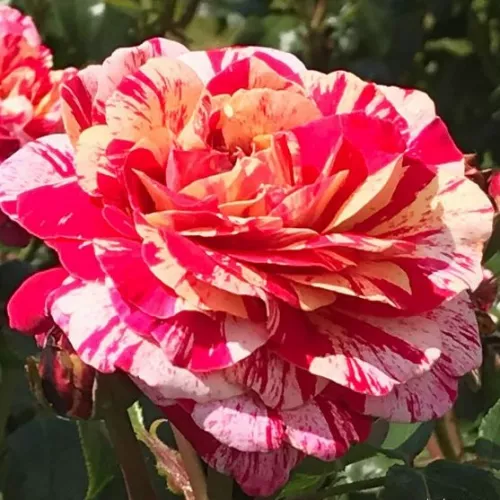
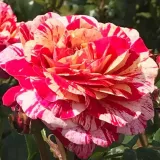
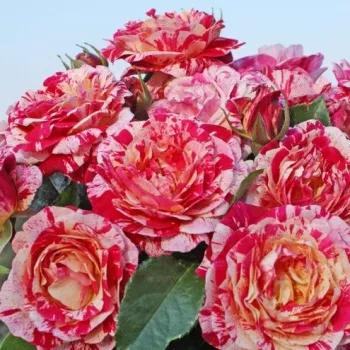
The petal ground colour is deep carmine red, crossed by lemon-yellow stripes. - flowerbed, floribunda rose - very weak, barely noticeable scented rose - delicate, classic rose character
– Striking red-yellow Abracadabra ® stripe effect
– Bushy, upright habit for structured beds
– Glossy, dark green foliage adds elegance
– Good colour retention, even in strong sun
– Decorative orange-red hips extend the season
– Special feature: Remontant floribunda with abundantly repeated flowering for long-lasting colour.
Elegant spaces – Responsible plant selection
darinaROSE® ORIGINAL 2-litre own-root potted rose
19,00 £
Unfortunately, we are currently unable to ship to the United Kingdom; we only deliver to countries within the European Union. For more information, please contact us!
5(9784)
ABRACADABRA ® – red-yellow bedding floribunda rose - Kordes
Bring storybook magic into a real family garden with Abracadabra, a compact floribunda whose striped blooms create a cottage-style spectacle from summer onwards. Its upright, bushy habit and dense, glossy foliage mean the plant quickly looks established, while the own‑root form supports long-term resilience and reliable regrowth after colder winters. Ideal for small to medium beds and along paths, it offers abundant clusters of large, semi‑double flowers that repeat well, so borders do not need constant replanting. Carefully chosen breeding gives reassuring stability in performance even in breezy, rain‑washed sites near the coast, provided soil drainage is sensibly managed. In its early years the plant quietly invests in roots, then develops stronger shoots, before reaching full ornamental value by around the third season, rewarding patient planning and gentle care with a cosy, romantic cottage‑garden feel.
Close-up of the moderately thorny stems of Abracadabra®.
Freshly opened Abracadabra bloom with vivid carmine-red and cream-yellow streaking.
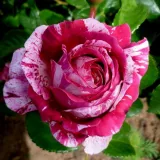
Closed bud of Abracadabra ® with raspberry-red base and white marbling.
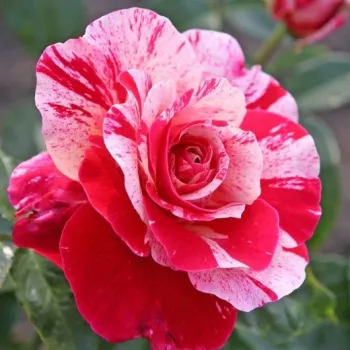
Abracadabra in full bloom, showing its red and cream striped flowers.
Usage options
Target area
Reasoning
Front to mid flowerbed in a family garden
The compact, bushy habit and 80–110 cm height make it easy to place in mixed borders without blocking views or children’s play areas. Repeating clusters of large, semi‑double blooms provide colour from mid‑season onwards with only light deadheading, appealing to the time-poor beginner.
Cottage-style edging along a path or lawn
The upright, evenly spreading shape (50–80 cm) creates a low, informal hedge that frames paths and lawns without feeling rigid. Dense, glossy foliage stays attractive between flushes of bloom, so the edging looks cared-for even when you have limited time for detailed maintenance.
Feature rose in a small bed or island border
The striking striped red‑yellow flowers stand out beautifully as a single focal plant in a modest bed, giving a sense of design without complex planting plans. Own‑root growth helps the shrub recover if pruned harder, supporting a long-lived, dependable centrepiece.
Mixed cottage border with perennials and shrubs
Its warm, variegated colouring blends well with soft purples and creams, while the floribunda habit ensures repeated flowering among perennials. The moderate disease tolerance suits typical UK gardens where occasional care is acceptable but constant spraying is not, reassuring the relaxed gardener.
Informal low hedge in front of darker evergreens
The dense foliage and regular height allow planting in a loose row at 50–60 cm, making an attractive, low seasonal hedge. The patterned blooms show up clearly against darker backgrounds, offering visual rhythm with simple annual pruning that suits a traditional‑style homeowner.
Large container on terrace, balcony, or patio
In a 40–50 litre or larger container, the upright, bushy form and repeat flowering create a welcoming focus near seating. Own‑root structure copes better with occasional drying or harder winter pruning than grafted plants, supporting long service life for the busy urban dweller.
Family seating area or “tea corner” planting
The romantic, striped blooms and moderate hip display later in the season frame a cosy seating nook without overwhelming space. Medium maintenance requirements mean routine watering and light deadheading are enough for a neat effect, fitting a family who wants charm with limited effort.
Exposed or breezy suburban and coastal gardens
The sturdy, bushy frame, moderate hardiness and dense foliage give reassuring anchoring and structure where wind and rain can quickly spoil more delicate roses, as long as you provide a well‑drained planting spot in heavier soils, supporting the cautious yet style‑conscious buyer.
Styling ideas
Striped-centrepiece bed – Place Abracadabra as the central shrub in a small round bed with low catmint and soft grasses to echo its compact, upright form – ideal for homeowners wanting an easy focal point.
Storybook-path edging – Line a front path with repeated plants at 50–60 cm, underplanting with low thyme to set off the foliage and stable shape – suited to families seeking a welcoming cottage entrance.
Tea-corner trio – Group three plants near a bench in a 90 cm triangle, weaving in Knautia macedonica for airy contrast to the bushy structure – perfect for those creating a relaxed afternoon-tea nook.
Patio-feature container – Grow one plant in a 50–60 litre pot with trailing lobelia and heuchera to highlight its long-lived, own-root reliability – good for busy urban gardeners short on border space.
Evergreen-backdrop border – Plant in front of Ilex crenata or other dark evergreens, using its repeat flowering and dense foliage to soften the line – fitting for traditionalists wanting year-round structure.
Technical cultivar profile
Parameter
Data
Name and registration
Floribunda bed rose marketed as Abracadabra ® Fantasia®, registered as KORamsaro, exhibition name Abracadabra; shrub rose type for garden ornamental and flowerbed use.
Origin and breeding
Bred by W. Kordes & Sons in Germany around 2004, introduced 2014; parentage not disclosed, selected for distinctive striped flowers and reliable garden performance.
Growth and structural characteristics
Bushy, upright shrub 80–110 cm high and 50–80 cm wide, with dense, glossy dark green foliage and moderate prickles; weak self-cleaning so spent blooms benefit from removal.
Flower morphology
Large cupped, semi-double flowers with 13–25 petals, produced mainly in clusters; repeat flowering with a strong second flush, providing extended seasonal display in beds and borders.
Colour data and phenology
Deep carmine-red base with lemon-yellow stripes, giving a red–white striped effect that softens to burgundy‑raspberry and creamy tones; colour holds well, only moderately lightening in strong sun.
Fragrance and aroma
Delicate classic rose character with very weak overall intensity; semi-double flowers moderately attract pollinators, as partly obscured stamens limit nectar and pollen accessibility.
Hip characteristics
Produces moderate numbers of small, spherical orange-red hips, around 6–10 mm in diameter, extending seasonal interest into autumn where spent flowers are not removed.
Resistance and winter hardiness
Rated H7, hardy to about −21 to −18 °C; moderate tolerance of heat and drought with watering in dry spells; disease resistance moderate to black spot, powdery mildew and rust.
Horticultural recommendations
Best in sunny sites with well-drained soil; spacing 50–90 cm depending on use, 2.8–3.2 plants/m² for mass planting; suitable for beds, edging, specimen use, parks and cutting.
Abracadabra ® brings compact structure, repeat flowering and enduring own-root reliability to family gardens, making it a thoughtful choice for those planning a long-lived, romantic rose feature.
Flower Colour Description:
The petal ground colour is deep carmine red, crossed by lemon-yellow stripes.
Closed Bud:
Raspberry to crimson-red base, with white marbling and scattered speckling visible at the edges.
Newly Opened Flower:
On a vivid carmine-red ground, irregular cream–butter-yellow, in places peach-coloured streaks and splashes appear on the inner surface.
Full Bloom:
A red–white 'striped' effect dominates; the red areas tend towards a slightly raspberry shade and the whites may turn creamy.
Before Fading:
The red tone softens, turning to a burgundy‑raspberry; the light bands can take on a creamy, slightly yellowish hue.
Pollinator Attraction:
Semidouble (simple/semidouble/double) 13–25‑petal flowers moderately attract pollinators, as the semidouble form and partially obscured stamens reduce pollen and nectar accessibility compared with simple blooms.
Our product is a rose grown with pharmaROSA®’s unique cultivation technology!
2-litre, own-root, potted rose.
With a shoot system appropriate to the season.
With a root system that thoroughly permeates the growing medium.
Quality compliant with the requirements of the E.N.A. (European Nurserystock Association).
Supplied in unique packaging that prevents damage.
Can be planted during frost-free periods.
True-to-variety rose bush with a unique identifier.
The pharmaROSA® own-root potted rose is a well-rooted plant that supports reliable establishment when planted and cared for properly, so it can be planted whenever the soil is not frozen.
Crop overview: several varieties and growth stages in a short crop section.Shoot system: intensive growth of fresh basal shoots on a young plant.Root system: demonstration of a vigorous root system permeating the growing medium, by removing the pot.Balance: mature plant with root system and shoots in harmony with each other.
Information about the videos
The video series is not a “seasonal showcase”; it illustrates the essence of pharmaROSA® own-root cultivation in a tangible way: how the plant is built up, what the root system is like and how the shoot system regenerates. The recordings were therefore made at different times and with plants at various stages of development, so mixed foliage levels and differing stages of growth may appear in the videos. They are not a ‘sample’ of the batch dispatched, but a visual explanation of how the technology works. The current condition of the rose available to order — typical for the given period and similar to what you can expect to receive in the parcel — is shown in the upper part of the product page.
Pages for private customers Garden roses for the family garden, with minimal care → ORIGINAL® Premium garden roses – instant impact, a truly showpiece garden → EXTRA® Pages for professionals and private customers Roses for public spaces – large areas, sustainable maintenance → NATURAL® Roses for projects – hedge and row planting, fast implementation → RAPID® For professional partners only Production – propagation material for garden roses, wholesale → NEONATAL®
Company details
PharmaRosa Ltd. Company registration number: 01-09-717479 VAT number: 13075314-2-43 Plant health registration no.: HU130721 Bank account (IBAN): HU85117631891388688400000000 BIC (SWIFT): OTPVHUHB Bank name: OTP Bank Nyrt.